Today I finished day 2 of the Q Grading Class. In this blog post, I’ll try to get more into the nitty gritty of what taking the Q is like, after I tried to do a bit of an overview yesterday. The takeaway? It’s really hard!
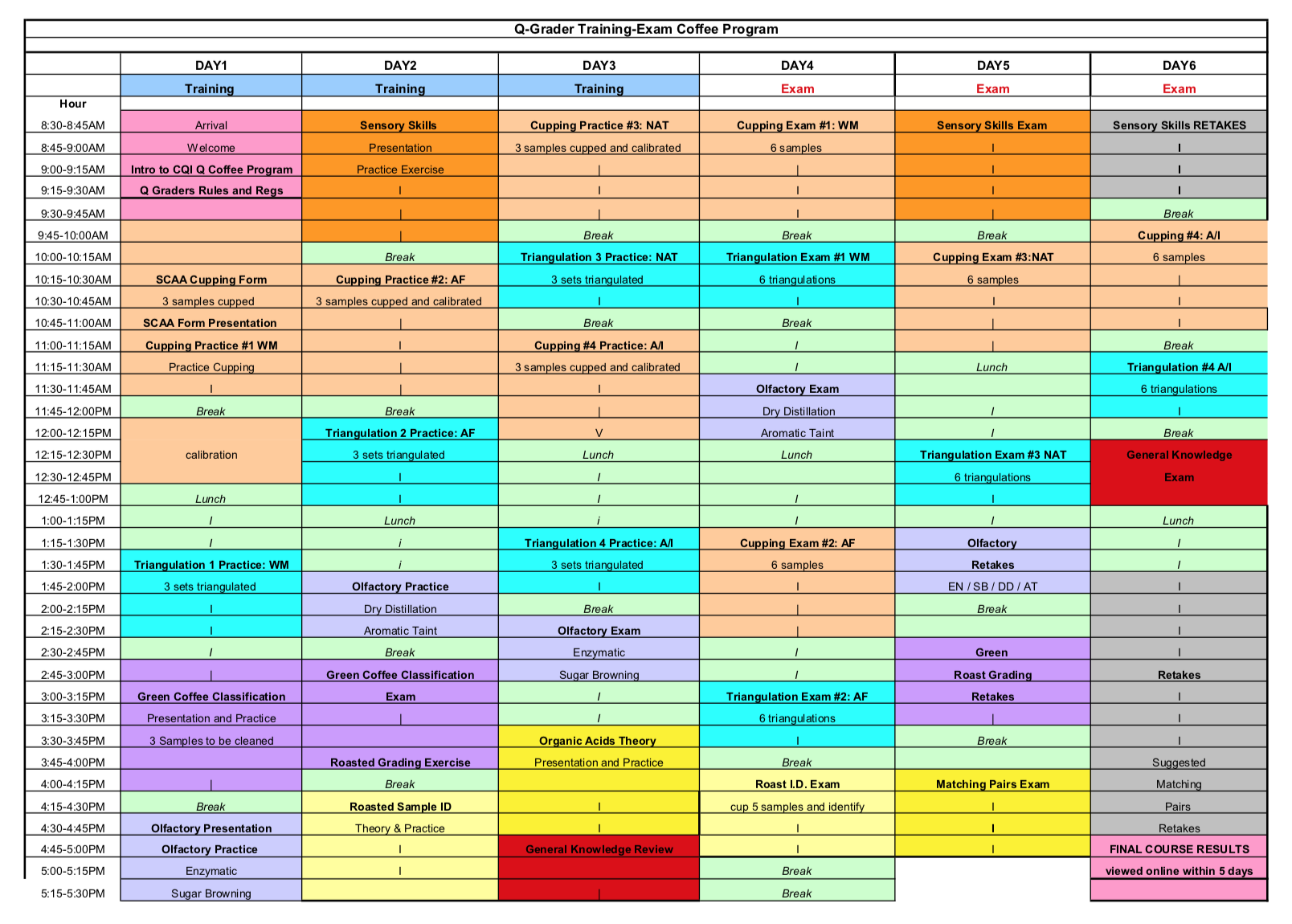
As I mentioned yesterday, the Q has 20 tests in total. They are:
- General Knowledge Exam
- Cupping 1 – Washed Milds
- Cupping 2 – Africans
- Cupping 3 – Naturals
- Cupping 4 – Asians
- Triangle 1 – Washed Milds
- Triangle 2 – Africans
- Triangle 3 – Naturals
- Triangle 4 – Asians
- Olfactory 1 – Enzymatics
- Olfactory 2 – Sugar Browning
- Olfactory 3 – Dry Distillation
- Olfactory 4 – Aromatic Taints (defects)
- Sensory Skills 1 – Intensity Sort
- Sensory Skills 2 – Modality and Intensity Sort
- Sensory Skills 3 – Mixed Modality and Intensity Sorting
- Green Coffee Grading
- Roasted Coffee Grading
- Roast Sample Identification
- Organic Acids Matching Pairs
In order to pass the Q, you have to pass all 20 tests! Luckily, you’re able to retake almost every test up to twice during your 6-day Q, depending on time and space constraints. The only tests you can’t retake are Cuppings and General Knowledge. After your Q, you have 18 months to retake other parts that you didn’t pass your first time around to get your Q certificate. Each test has a different passing criteria. Today, I’ll talk about the olfactory tests, sensory skills, and roast sample ID. Tomorrow I’ll try to get more into the cupping tests and triangulations.
Olfactory Tests: Enzymatic and Sugar Browning
The olfactory tests measure your sensory ability to recognize and identify smells from the Le Nez du Cafe kit of aromas in coffee. Le Nez is a very fancy wooden box of 36 fancy perfume vials of aroma extracts that are commonly found in coffee. They are separated into 4 categories with vials 9 each. The categories correspond to four aromatic categories that a guy named Ted Lingle came up with for coffee tasting: Enzymatics, Sugar Browning, Dry Distillation, and Aromatic Taints. If these categories sound weird, they definitely are, but there’s some justification for them (except dry distillation – no one has any idea where that one’s from).
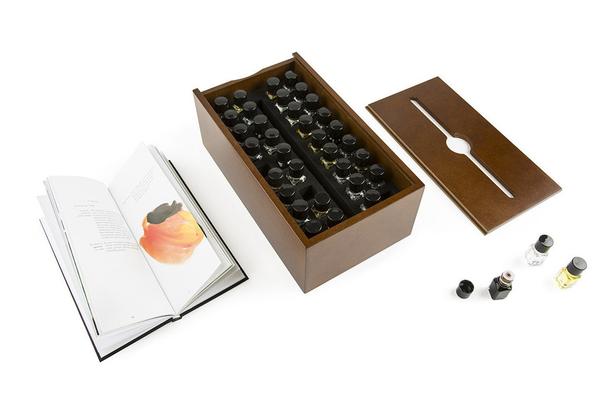
Enzymatic aromas are typically due to some enzymatic process in the biology of the coffee plant, like cellular respiration. They tend to be fruity and plant-like. The 9 aromas are: Potato, Garden Peas, Cucumber, Tea Rose, Coffee Blossom, Lemon, Apricot, Apple, and Honey.
Sugar Browning aromas are due to the breakdown of amino acids into simple sugars through the Maillard reactions during the coffee roasting process. They are generally sweet and nutty – the kind of smells you might readily associate with coffee. They are: Vanilla, Butter, Toast, Caramel, Chocolate, Roasted Almonds, Roasted Peanuts, Roasted Hazelnuts, and Walnuts.
Dry Distillation aromas are due to a loss of fibrous organic matter that burns and breaks down into generally undesirable smells, most commonly associated with darker roasted coffees. They are due to the carbonization of sugars in the later stages of the roasting process. They are: Cedar, Pepper, Licorice, Clove, Malt, Black Currant, Pipe Tobacco, Coriander Seed, and Roasted Coffee.
Aromatic Taints are bad smells that can be due to any number of defects in the coffee production lifetime, from agricultural issues to processing issues to storage issues. Personally, I really like the Coffee Pulp aroma because it smells nice and fruity to me, but many coffee professionals view it as a defect due to over-fermentation in the coffee drying process. The aromas are: Earth, Leather, Straw, Coffee Pulp, Basmati Rice, Medicinal, Rubber, Cooked Beef, and Smoke.
The Olfactory Skills test in the Q tests your ability to match and recognize smells from Le Nez. During the test, which you take in a room with red lighting to reduce your ability to see the color inside the vials (even though the testing vials are already taped over!) you are presented with two trays. On one tray is the familiar 9 aromas from the category you’re being tested on, with their numbers visible – this is your reference sample. On the other tray are 6 vials that are taped over with masking tape, each with a letter written on the tape. You have to match each of the 6 vials to the correct number aroma, and identify the name of 3 of the 6 vials.
Today we practiced and tested the Enzymatic and Sugar Browning categories. What was extremely frustrating, though, was that the test kit and the practice kit (which was also the reference kit during the test) were noticeably different in smell! By now, my nose is calibrated enough to detect these differences, and the reference kit’s vanilla had a sharp pungency lacking in the testing kit, while the testing kit’s roasted peanuts had a buttery aroma that was totally not there in the reference kit. These differences were likely due to differences in the amount of use the two kits get (the practice kit gets smelled a lot more frequently) and different exposures to sunlight/humidity. Luckily, I was still able to figure them out and ended up passing both of today’s olfactory tests!
Sensory Skills – The Really Hard One
Sensory Skills is one of those tests that everyone who goes through the Q remembers quite well. It’s a bit like the final in my physics 105 class – kind of absurdly difficult. The sensory skills test measures your sensitivity to sweet, sour, and salty tastes through recognizing them in aqueous solutions. There are three distinct tests in the sensory skills test: Ranking Intensity, Identifying Intensity and Modality, and Identifying Mixed Modalities and Intensities.
In the ranking intensity test, you are given 3 cups of water that all have the same flavor added to them – say, 3 cups with some amount of sugar in them. You are asked to rank the 3 cups in order of least to most intense. Repeat this for each modality (also known as a flavor) This one is relatively straightforward. The sweetest, saltiest, and sourest cups are really pretty intense to drink, though! Luckily, you have lots of clean rinse water to rinse your mouth out with.
In the identifying modality and intensity test, you are given 9 cups. These 9 cups are the same 9 cups you just ranked in intensity, meaning you have one of each cup for each modality and intensity. You first sort the cups by modality, then rank the intensity among the groups.
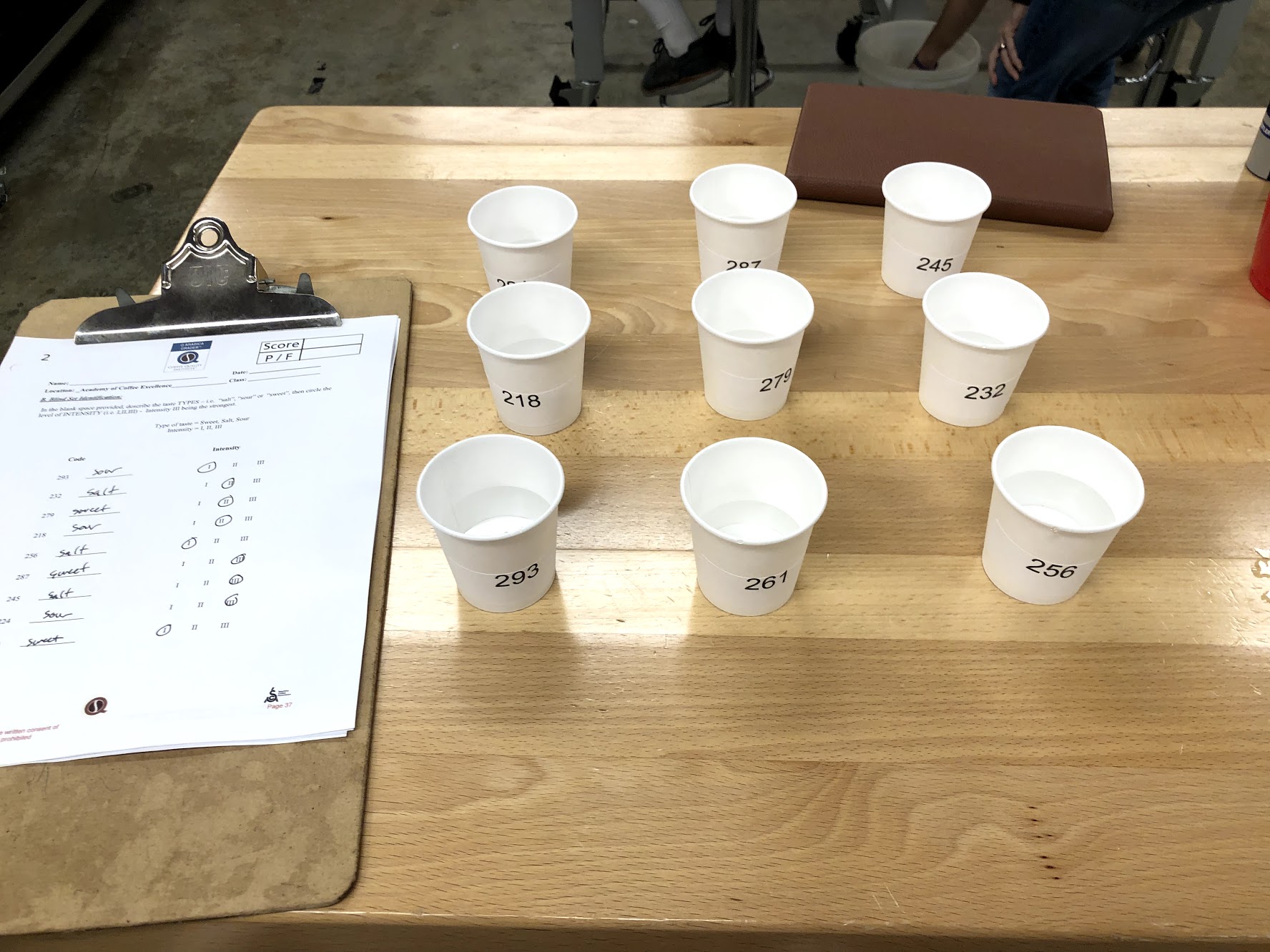
Lastly, you do the identifying mixed modalities and intensities. So far, sensory skills has seemed pretty straightforward. Here’s where it gets intense. In mixed modalities, you are given 8 cups. 4 of the 8 cups have two distinct mixed modalities in them at varying intensities. The other 4 have … all 3 modalities in them, at varying intensities! That means you’re sorting a cup of intense saltwater with one drop of citric acid and one drop of sugar, and you have to identify the modalities present and their corresponding intensities. This one is super tough.

After we silently completed the second test (unique modalities/intensities), we went over the scores together as a group. All of us got all 9 of them right, which was pretty bangin’. The instructor assured us that the previous practice was done under proper testing conditions because he didn’t help any of us and we all completed it in the timeframe, so we counted it as an official test! For those keeping count, that’s 3 tests done – 2 olfactory and a sensory skills!
Roast Sample ID
The Roast Sample ID test measures your ability to identify whether a roasted coffee is roasted within the CQI standard for coffee samples. Unlike the roasted grading, you are not picking out beans here but rather tasting coffee. There are four possible roasts, always of the same coffee:
- SCA/Spec – fits CQI specifications
- Under – under-roasted/developed: typically sour, vegetative, undeveloped, not very sweet
- Over – over-roasted/developed: typically smokey, not sweet, muted acidity, unbalanced body
- Baked – “baked” during roasting (temperature change too abrupt or flat): typically flat acidity, papery taste, medium body
The CQI actually just changed this test to a new format! We were first given the 4 roasts on one table with their labels on face-down post-it notes we could peek at, to better understand and learn the categories.
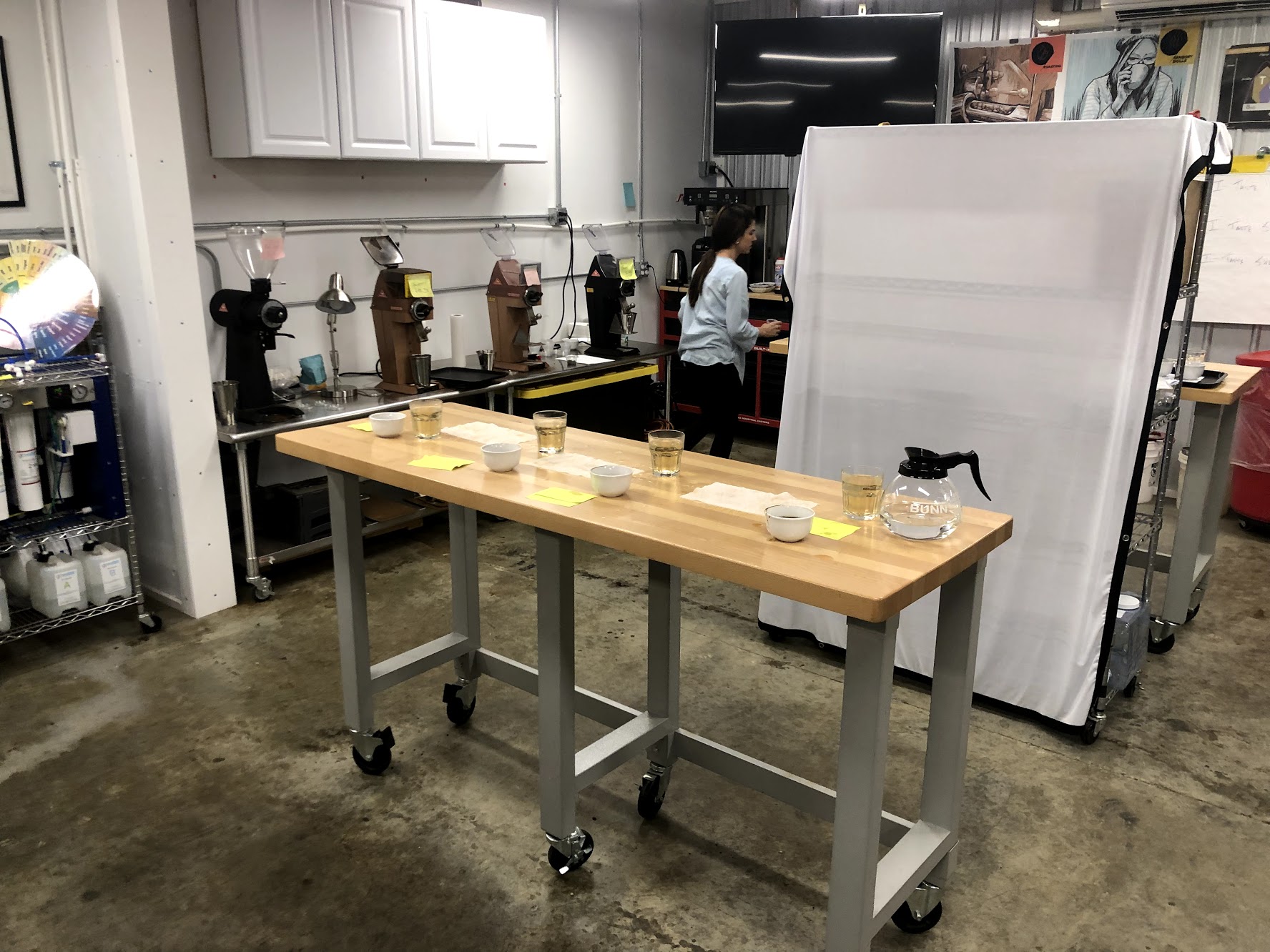
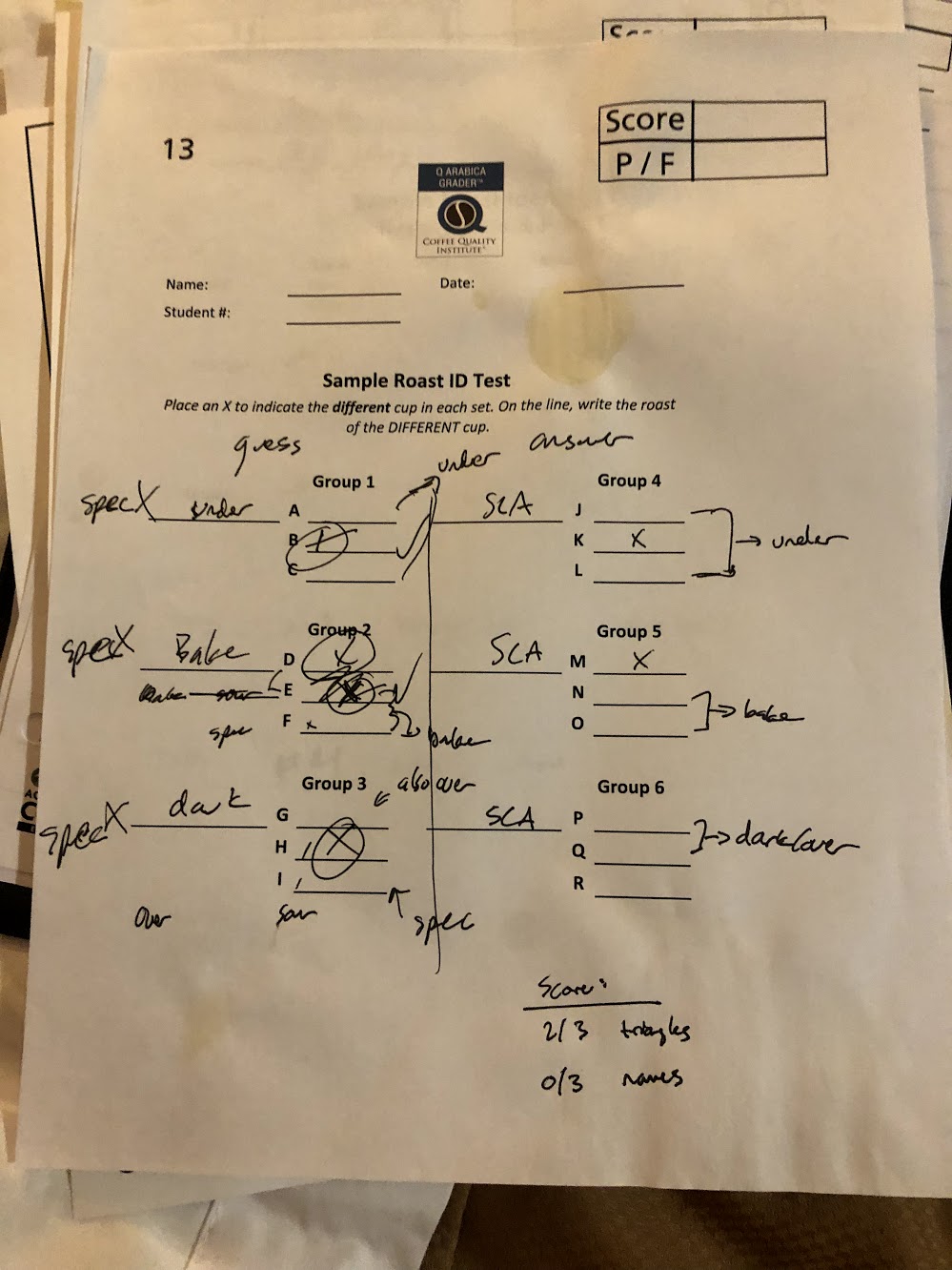
After talking about the differences in flavor, I was pretty convinced that I had this down. So we moved on to a half-scale practice exercise. The actual roast sample ID test is another triangulation test (this is new – it used to be just ID’ing them on the same table you see above). Each triangle has the spec and a roast defect. This means that there are either 2 cups roasted to spec and one odd one out roasted wrong, or 2 cups roasted wrong and 1 cup roasted to spec. You have to pick the odd one out and identify the odd one out as spec/under/over/baked. Interestingly, if the odd one out is spec, you don’t have to write the roast defect of the other ones.
Like many coffee sensory tests, this exam is done under red lighting so that you can’t see differences in the coffee (and to make it harder to find your clipboard). It gets pretty dark in the room, so you’re really totally relying on your nose, tongue, and knowledge.
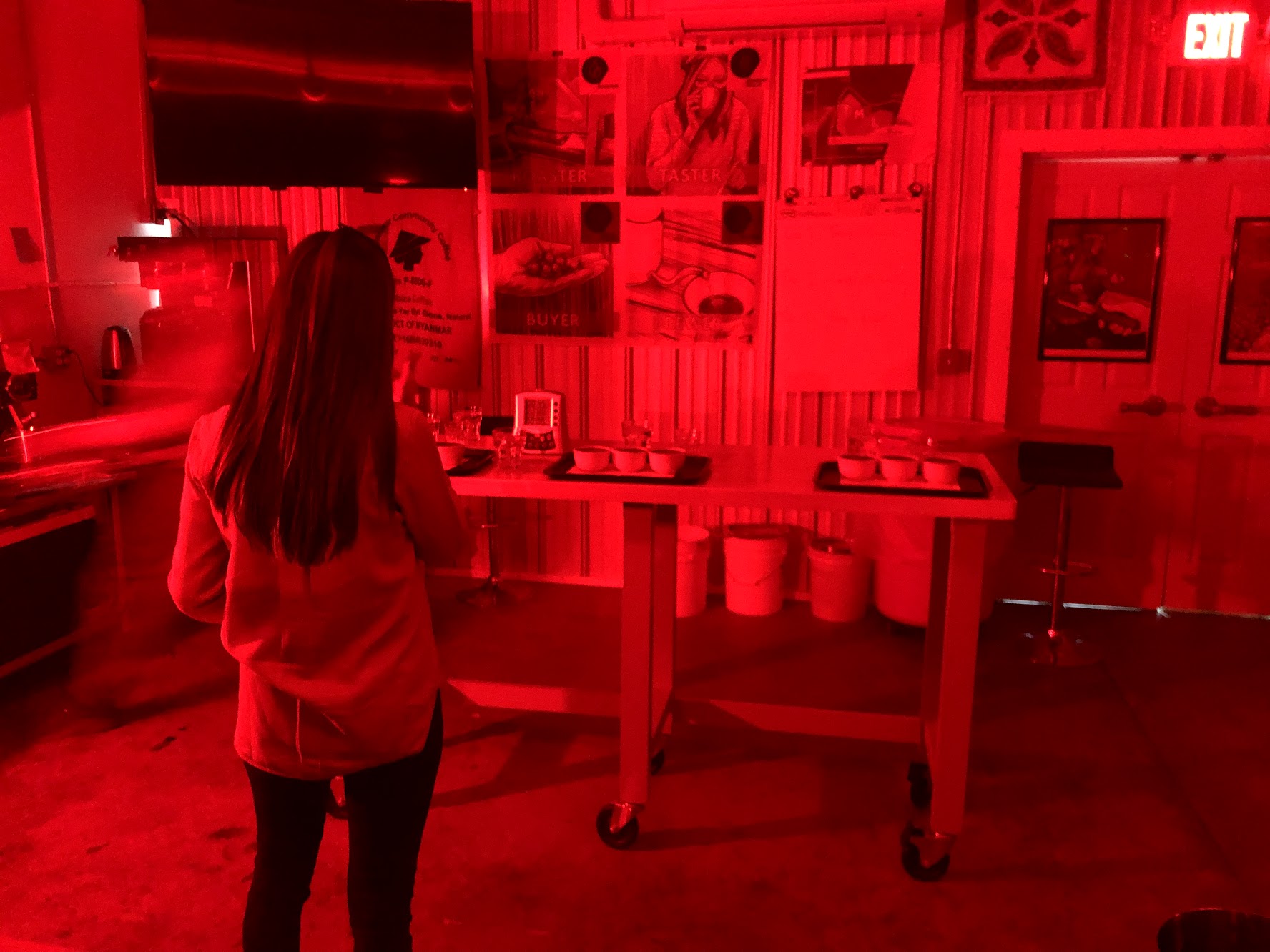
I totally failed this one. Our practice couldn’t count for a full test even if we got them right, because it’s only 3 triangles instead of 6, so I’m ok. But man, was it hard. In the first triangle, two of the samples were under and the middle one was spec. I said that the middle one was under roasted and that the other two were spec. In fact, the middle one was spec and the other two were under roasted. I would’ve gotten 1/2 points here for getting the triangle right, even if I got the category wrong. In the second triangle, I said that cup 1 was baked and the other two were spec. Again, cup 1 was spec and the other 2 were baked! In case you think I was getting into a great pattern where I could just flip my results, though, I messed up the 3rd one differently: I said that cup 2 was dark while the other two were spec; actually, cup 3 was spec and 1 and 2 were dark. Close, but no cigar!
Are you feeling worn out yet? Imagine how I feel! Walking down the street after the test is kind of overwhelming because there are so many smells – “hey, someone’s gardening over there, I can smell Le Nez #3″ or “man, the gravel here really reminds me of a cardboard-ey defect.”
Ok, that’s Q Day 2! So far, I have passed 5 out of the 20 tests (albeit the 5 easiest ones, probably):
- General Knowledge Exam
- Cupping 1 – Washed Milds
- Cupping 2 – Africans
- Cupping 3 – Naturals
- Cupping 4 – Asians
- Triangle 1 – Washed Milds
- Triangle 2 – Africans
- Triangle 3 – Naturals
- Triangle 4 – Asians
- Olfactory 1 – Enzymatics – passed
- Olfactory 2 – Sugar Browning – passed
- Olfactory 3 – Dry Distillation
- Olfactory 4 – Aromatic Taints (defects)
- Sensory Skills 1 – Intensity Sort
- Sensory Skills 2 – Modality and Intensity Sort – passed
- Sensory Skills 3 – Mixed Modality and Intensity Sorting
- Green Coffee Grading – passed
- Roasted Coffee Grading – passed
- Roast Sample Identification
- Organic Acids Matching Pairs
Let’s keep checking these off! See you tomorrow!
Alex
 Alex's Coffee Adventure
Cool! That’s a lot of coffee knowledge packed into this blog. Luv u, get some sleep!
LikeLike
Which category is black currant in??
LikeLike