Now it gets hard
Today was the last day of practice for the Q, and I am exhausted! My tongue is totally worn out, but I’m feeling a lot better about the next few days. From here on out, it’s all testing all the time. We can retake all of the tests besides cuppings and the general knowledge exam, so at least we’ll get another shot if some of them go poorly. I’m most worried about triangles and defect identification in cupping, but I am feeling a lot better about these after today.
Today, we learned the other 2 categories of Le Nez, cupped natural coffees, triangulated naturals, cupped then triangulated Asian coffees, practiced Le Nez, learned about and practiced tasting organic acids, and reviewed general coffee knowledge for the written exam. It was absolutely jam packed – I probably slurped up coffee more than 200 times today, so my tongue is very fatigued. (We spit out the coffee into spit cups after tasting so that we don’t all go crazy with caffeine.) I ended the day with a gratifying dinner of plain spaghetti with butter, straight from the kids menu at the Italian place next to my Econolodge. In this blog post, I’ll talk a bit about what Q cupping is like, my strategy for the triangulations, and explain the organic acids test.
The Coffee’s in Charge: Q Cupping
Cupping coffee at the Q is certainly stressful, because the whole dynamic is switched. Usually, at a cupping table, you’re the one in charge: you, as a cupper, are there to grade the coffee. At the Q, the coffee is in charge, meaning your only purpose is to accurately describe the coffee as it is presented to you. When you’re in charge, you tell the coffee its worth, but when the coffee’s in charge, it tells you your worth!
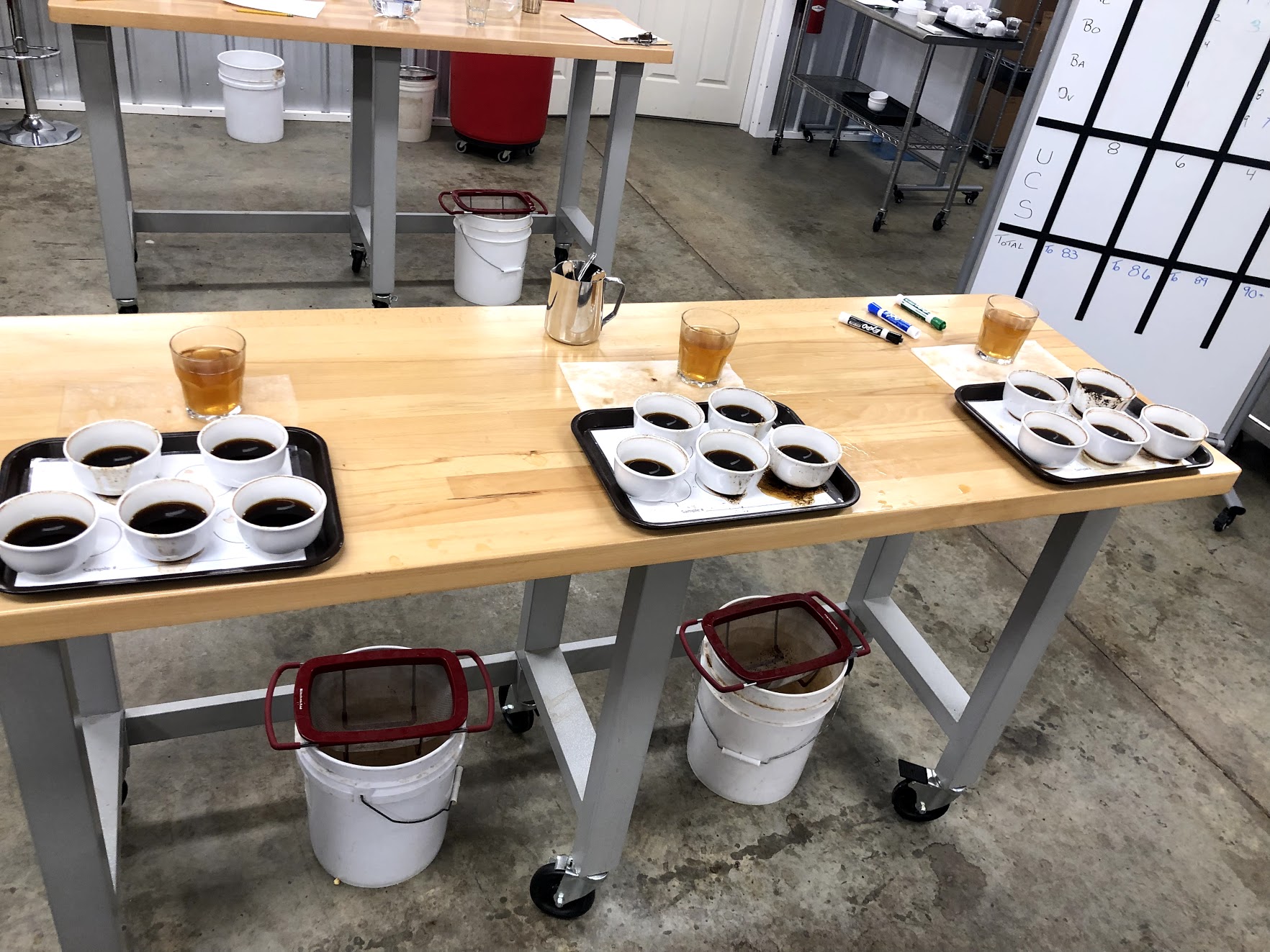
We had a tricky day at the cupping table. First, we cupped naturally processed coffees, which are generally fruitier and more complex than washed coffees due to the differences in processing the cherries. The naturals we had today were absolutely fantastic: I scored them at 88.25, 87.25, and 85. That is very, very good coffee. The 85 point coffee had a defect which brought my total score of it down to about 77, although we had some internal debate whether the defect was a fault, which knocks off an additional 4 points, or a taint, which only knocks off an additional 2. (The coffee already automatically loses at least 4 points for having a defect due to the Uniformity and Clean Cup categories of the cupping sheet). The instructor assured us that either scoring was valid as long as we had adequate justification.
What’s exciting about the naturals cupping was how well calibrated we became as a group. Calibration refers to the relative scores of different graders. Ideally, all Q graders in the world are perfectly calibrated to one another, meaning they’d score every coffee the same within a quarter of a point. In reality, Q graders generally agree on the caliber of coffees although they may differ by up to 2 points on a final score.
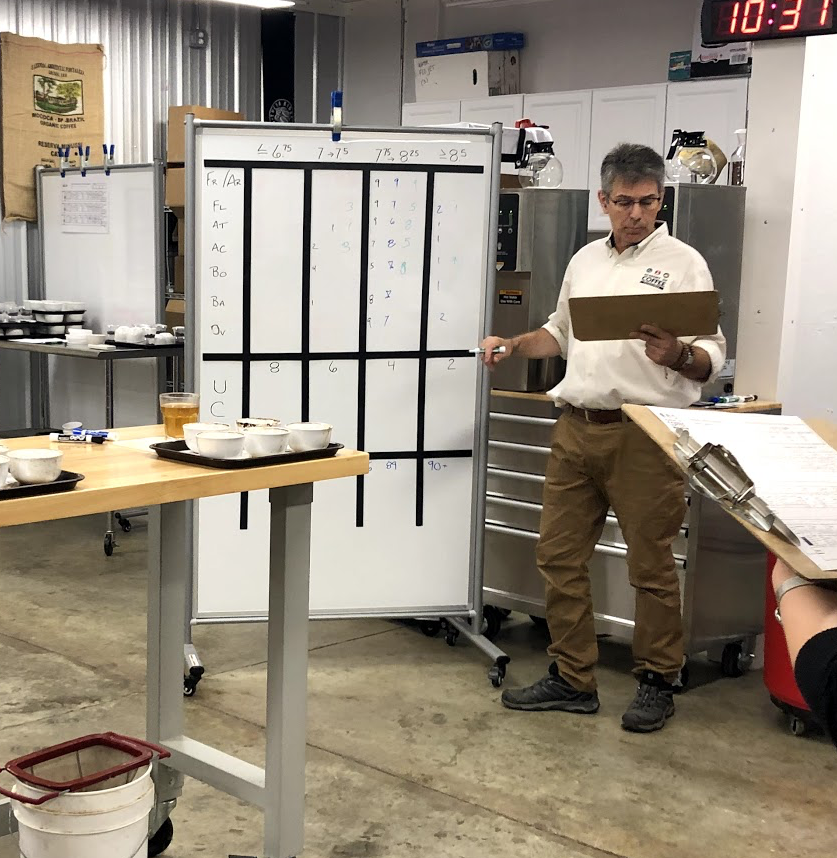
As I said, we ended up being very well calibrated as a group. As I said, I scored the coffees at 88.25, 87.25, and 85. Todd scored them at 87.25, 86.25, and 84. Almost a perfect correlation across groups, which demonstrates that I’ve gotten very discerning in my taste! The 1 point difference is well within reason (i.e. passing), and probably due to the fact that I’m a huge fan of fruity coffees. The 85-point coffee had a phenolic defect in cup 2, which brought its score down to about 79 or 77, depending on one’s perceived intensity.
As you can almost see on the calibration whiteboard, we end up grouping the coffees into 4 or 5 basic categories: below 80, meaning below specialty grade; 80-83, or good specialty grade; 83-86, great specialty coffee; 86-89, exceptional specialty coffee, and 89+, or outstanding specialty coffee. It’s important to keep in mind that all of these coffees are already excellent, and we’re just evaluating differences among already great coffees.
Next, we cupped Asian coffees: one generic commercial coffee, one from Java, and one from Myanmar. I scored them as 78.25, 84, and 86.25 respectively; the instructor scored them at 79, 84.5, and 83.5. Pretty good! I was pretty generous with the last one, and probably a bit high, but overall within passing range.
Unfortunately, on the Asian table I missed a defect. Defects, like I talked about the other day, can hugely impact cup quality. The 2nd cup of the commercial grade coffee had a phenolic taint to it, adding a chlorine-like flavor. This would’ve taken off about 8 points from the coffee’s final score (meaning the instructor actually got a 71, but a 79 after adding points back, so we graded the actual coffee pretty similarly). Missing a defect is definitely a mistake. I think I missed this one because I’m not really used to cupping bad quality coffees – the sample tasted mostly like wood and cardboard to me, which made me quickly gloss over most attributes. I think for the future, I’ll have to pay closer attention to every coffee no matter it’s grade to make sure I am accurately grading it as it is.
Triangles, Triangles, Triangles
For me, the hardest part of the Q is triangles. As I mentioned yesterday, in triangles you have to find the odd cup out of 3. This can be very very difficult for similar coffees. For example, in the washed milds triangulation practice, we had two coffees that tasted extremely similar – a balanced Peruvian coffee with some ripe berry notes and a well-rounded Costa Rican coffee with jasmine and grape-like acidity. (All of the triangulation coffees are the same as the ones we cup beforehand, so we have some reference to go off of.) They scored within 1 point of each other on the cupping table and had no major defects and similar bodies. Our only hope was probably in identifying the different types of acidity – the Costa Rican was a bit sharper than the Peruvian – but alas, few prevailed. In the washed milds triangles I had really no clue which of the 3 cups in set A was the Costa Rican or the Peruvian, or even the odd one out. Sets B and C of washed milds were a bit easier because they had the commercial coffee, so either 1 of the 3 or 2 of the 3 cups were very woody and cardboard-ey in comparison to the others.
I’ve spent a lot of after class today studying my cupping forms and my triangle forms to try to see where my senses line up. In fact, this is how I spent my dinner!
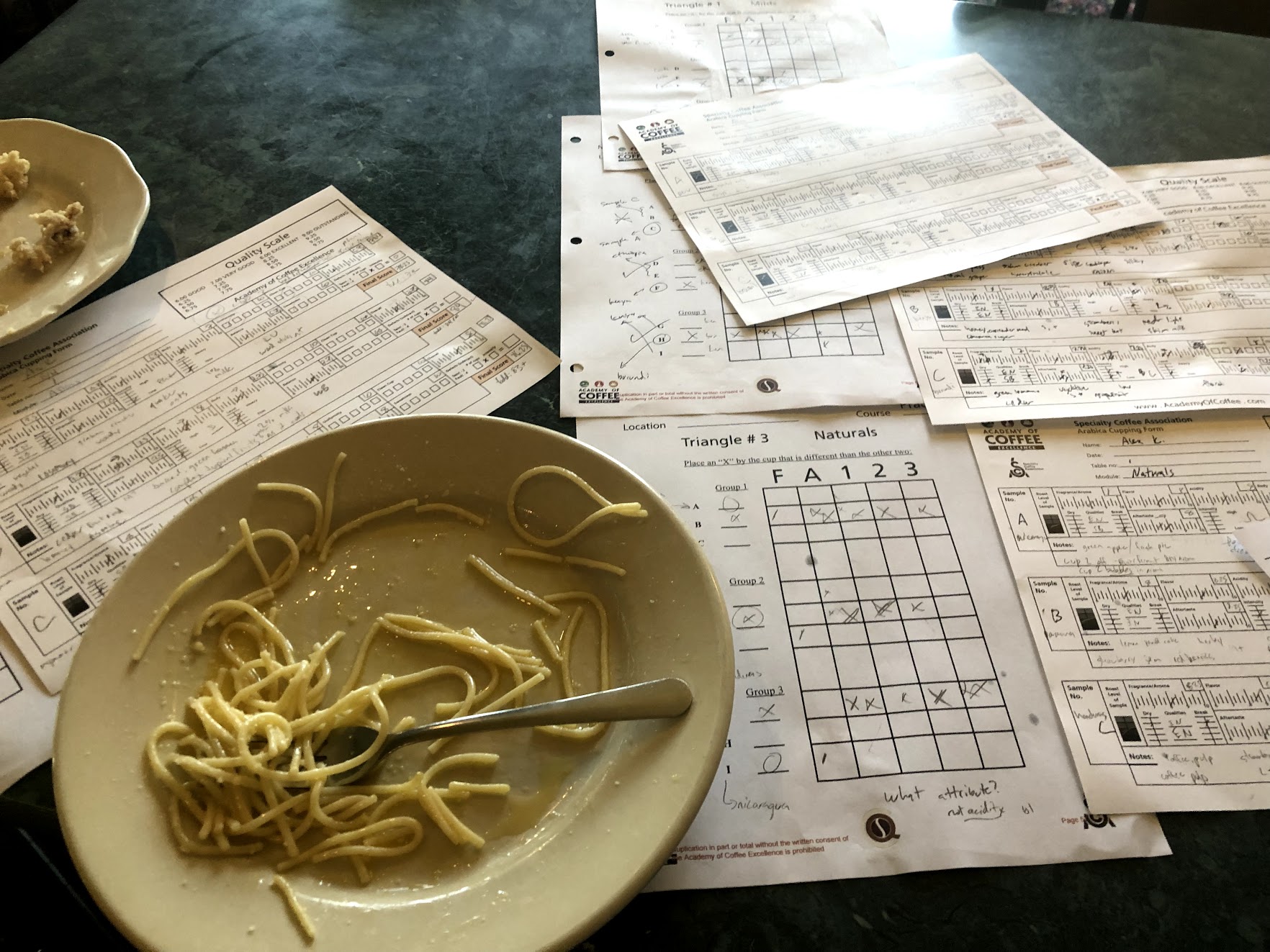
I think I have a plan for my strategy at future triangles. First, I’m going to get to know the coffees as best I can on the cupping table. Our instructor advises that we create a “four-word story” about the coffees that we can recognize and come back to during the triangles. For example, one of the natural coffees reminded me exactly of a strawberry milkshake due to its ripe berry flavor and creamy body. When we got to the triangle, I could feel the strawberry milkshake on my tongue and immediately picked the right cup out. It also helps that we can retake triangles this week, so I can see where I went wrong and recalibrate for the next round.
Organic Acids
At about 3:30 today, the instructor walked in and brazenly asked, “so, we all ready to trip some acid?” If you looked up “avuncular” in the dictionary you’d get a picture of this guy, ear-hairs and all, but he makes an amazing instructor for the Q.
The “Matching Pairs – Organic Acids” test was the last one we had to practice for. In the test, you are given 8 trays of coffee. On each tray there are 4 cups of brewed coffee (not cupped – it’s all in liquid form with no grounds at the bottom this time). 2 of the 4 cups of coffee are spiked with a diluted acid, while the other 2 are control samples. You are required to identify which cups are spiked and identify the acid. The 4 acids are citric acid, malic acid, phosphoric acid, and acetic acid. Everyone has their own tricks to remember them, and mine are pretty similar to most:
- Citric: sharp lemony flavor, hits your tongue immediately
- Malic: green jolly rancher, sour apple, 1 second delay on the mouth
- Acetic: vinegar. In low amounts, somewhat fruity. Very long aftertaste!
- Phosphoric: aftertaste of diet coke, kind of limestoney.
We had 2 different practice rounds: in the first, there were 4 trays, each with 2 cups. One of the 2 cups was spiked with the name of the acid below it, for us to get to know the acids and how they impact the coffee. The other was control. In the second practice round, we conducted the real exercise but half-scale (meaning only 4 trays instead of 8).
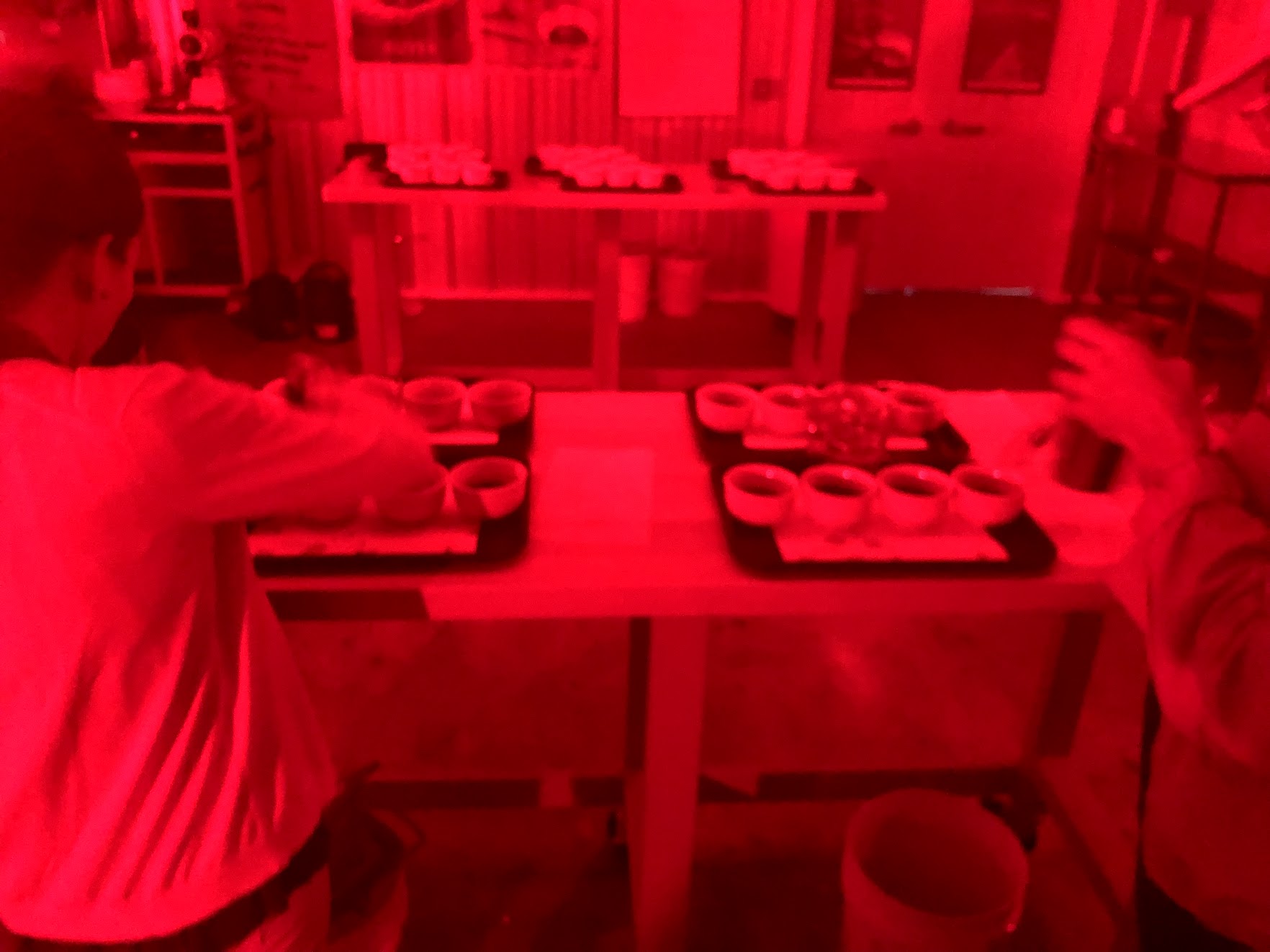
I did very well! I correctly identified all spiked coffees of the 16 on the table, and got the acids right for 2 of the 4 groups – I swapped malic and acetic. Feeling good about this one. It’s definitely a new skill, but it’s super interesting in its applications to coffee tasting. I think that identifying acetic acid will help me pick out phenolic defects much better in the future.
The big problem with organic acids is that your mouth gets absolutely wrecked by it. Slurping dozens of cups of acid-spiked coffee makes your tongue almost numb by the end of it, so we were all feeling pretty wrecked. Luckily, it was at the end of the day today and it’s scheduled to be at the end of the day during exam time. As mentioned, the delicious plate of spaghetti fixed me right up.
So that’s that, I guess: I’ve learned it all! Now is when I get to put my skills to the test. I’m feeling enormously better than I did 72 hours ago right now, and feel very capable going into these tests. As long as I trust my senses, don’t second-guess myself, and pay attention I think I’m in a good place.
I’ll write back tomorrow with hopefully another list of green test names. Until then, wish me luck!
Alex
 Alex's Coffee Adventure
Good luck!!
LikeLike
Incredible how far you’ve come already!
LikeLike
I so enjoy reading about this fascinating class! Thank you for sharing. I am very proud of you!
LikeLike