I started my official training to become a Q Coffee Grader today! This is the first big part of my adventure, and a hugely important one to help me prepare for what’s to come. In this blog post, I’ll try to explain the Q as best I can and tell you a bit about what my first day was like.
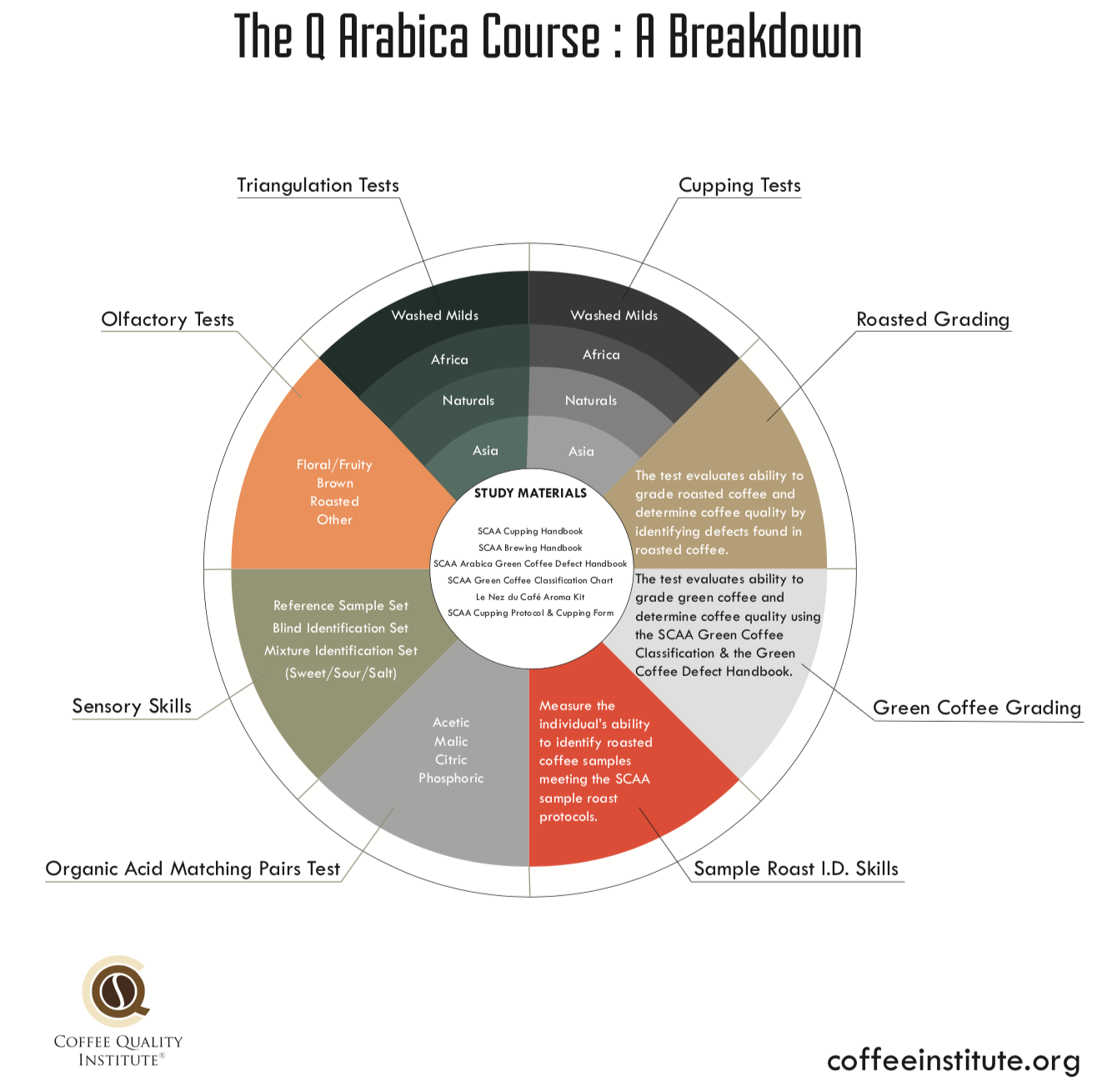
The Q Grader Program is a certification program offered by the Coffee Quality Institute (CQI). The purpose of the Q is to “create a skilled and credible body of coffee graders to consistently and accurately assess samples submitted for evaluation,” according to the handbooks we were given today. In other words, the Q is a way to create an objective standard for grading coffee. Hold on, let’s back up – why grade coffee?
Coffee is an interesting craft product because unlike wine, cocoa, craft beer, or whatever other fancy thing that Whole Foods sells you can think of, coffee can be objectively scored on a scale of 0-100. This is a tricky premise, because of course everyone tastes things differently, and everyone likes different tastes more or less. For example, if you gave my brother a fancy coffee, he would say it’s gross and get on with his day (love you Russ). My dad might chug it down while reading the paper and say it’s very nice. I might get really excited and say it’s the most delicious thing ever on earth. Who the heck is to say who’s right? (Definitely not Russell. Love you though) Well, if you gave a Q grader this sample, she would treat it very differently, evaluating specific criteria of the coffee and would end up telling you a precise number and grade that defines its quality.
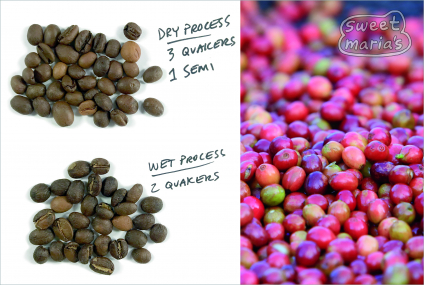
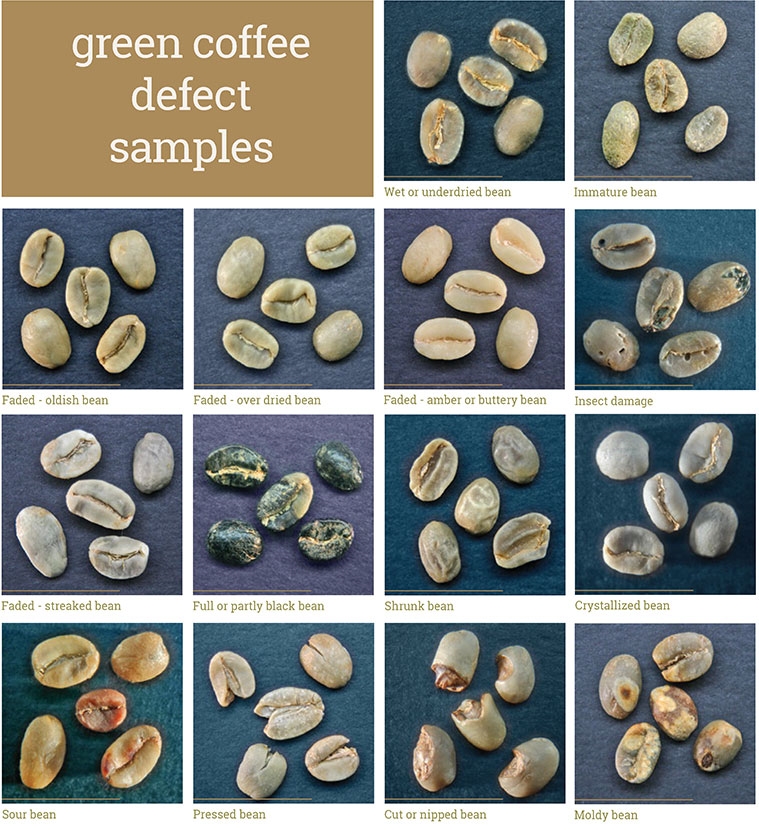
Thus, the Q Program is basically an exercise in 3 things: grading green (or unroasted) coffee, grading roasted coffee, and scoring coffee via cupping. Grading green and roasted coffee, both of which we did today, is done almost entirely by visual inspection of the beans, examining them for defects. “Cupping” coffee, on the other hand, is something very different.
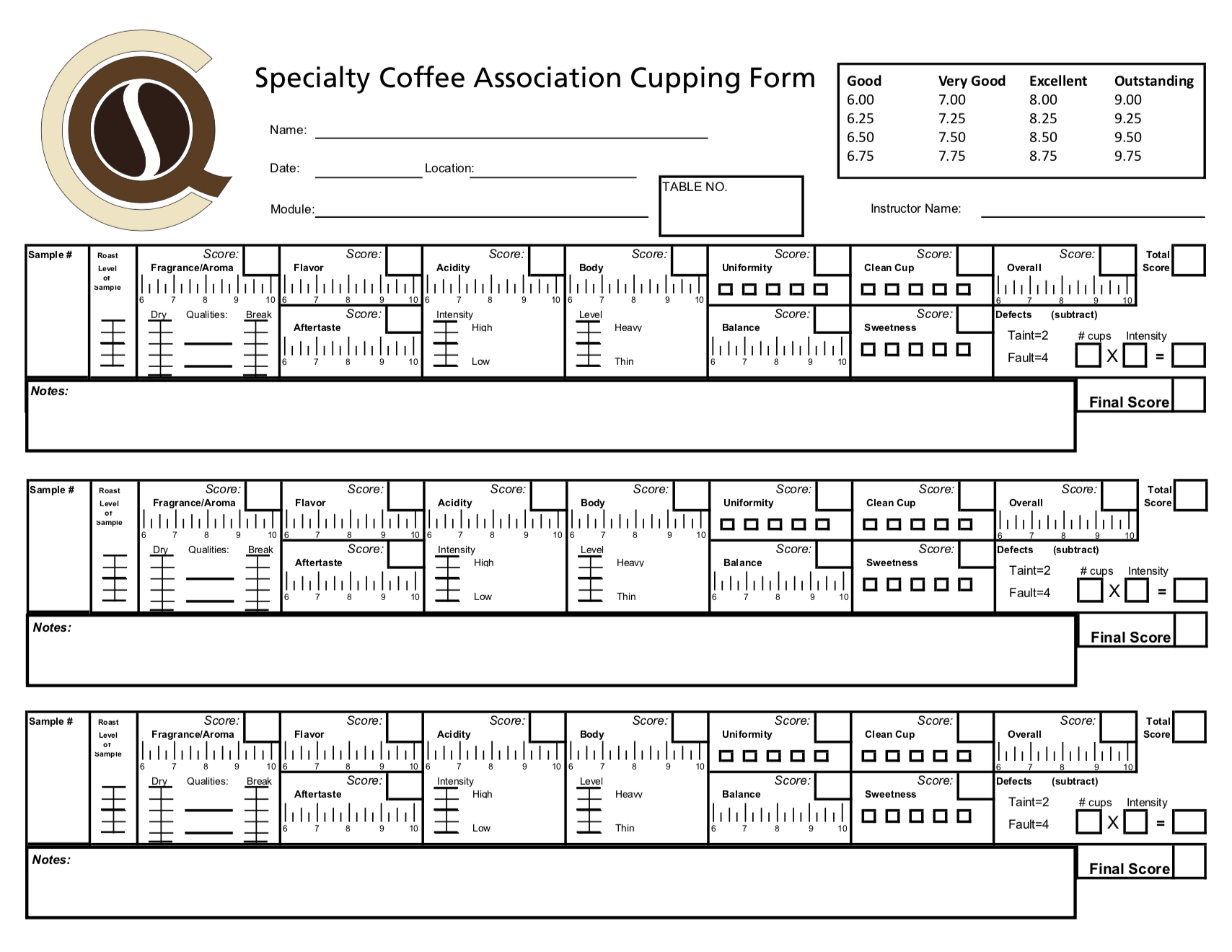
Ok, I’ve been beating around the bush. The real purpose of the Q is to properly score coffee on the Specialty Coffee Association (SCA) scoresheet. This means you can walk up to a table, taste a coffee, and give it a score from 0-100. Well, it’s not quite as simple as that, but it almost is.
Coffee scoring is done via cupping, which is a very standardized and repeatable way to brew coffee. Unlike wine, coffee needs to be brewed each time it’s tasted, so it’s important that one grader isn’t using a french press while the other makes an espresso – their coffees would taste very different! In coffee cupping, you grind 8.5 grams of properly roasted coffee per 150ml of 200ºF water. Most places use “bowls” for cupping that are bigger than 150ml at around 7oz, so the amount of coffee proportionally increases to about 11 grams.
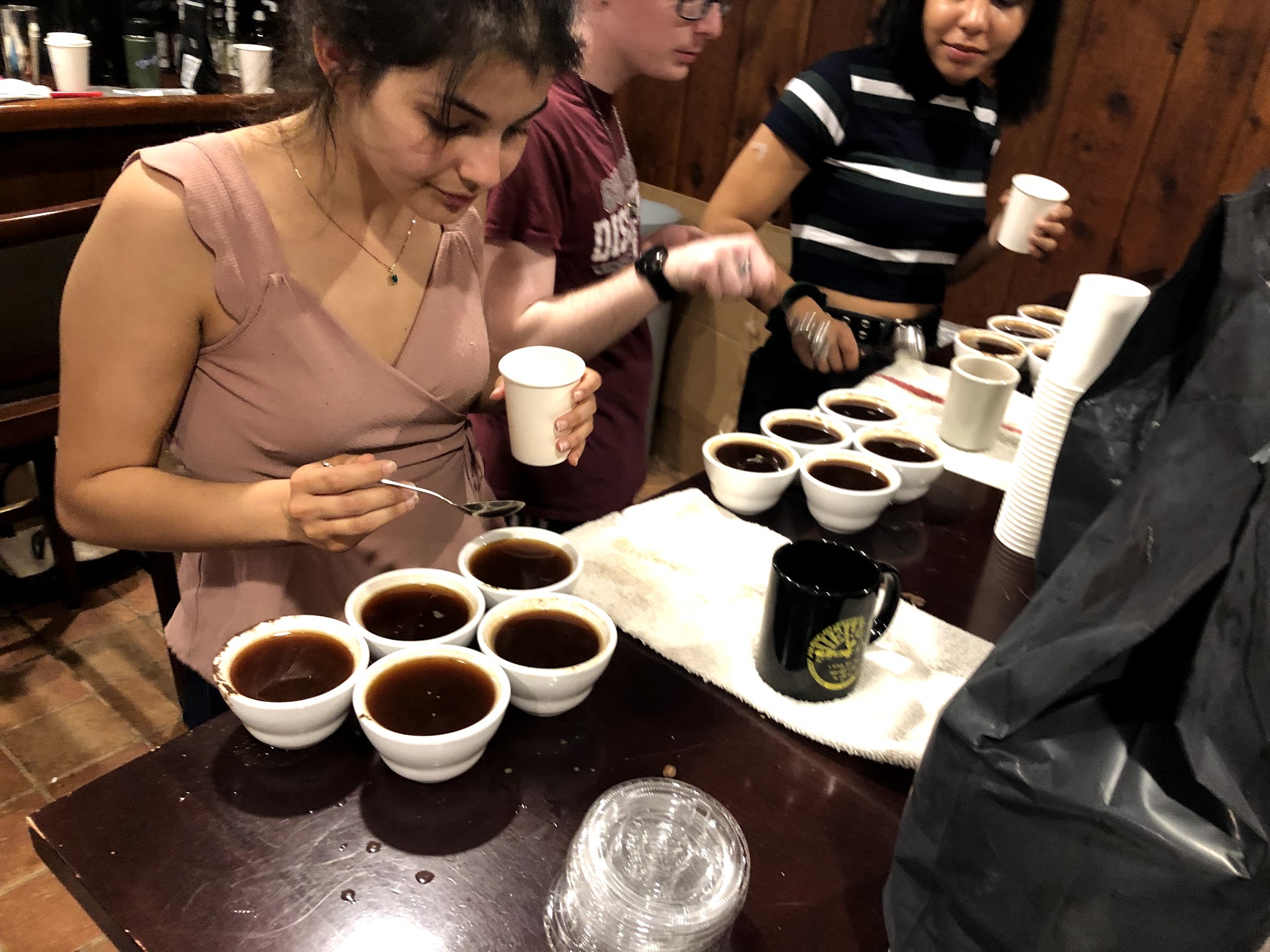
A cupping we did at Princeton Coffee Club! 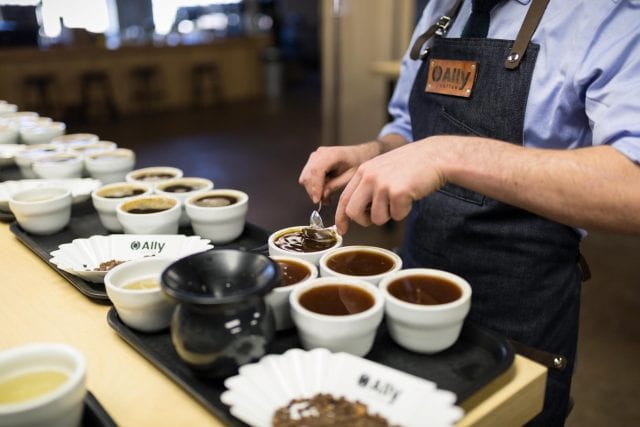
A little more of a legit cupping, done at coffee importer Ally
You use 5 cups for each sample, and separate the samples into groups. Cupping is always done blind, meaning you know nothing at all about the coffee, which helps reduce bias and predispositions. The steps of cupping are as follows:
- Measure out beans, prep samples
- Grind beans to grind size spec (medium-fine)
- Smell and score dry fragrance of grinds
- Add 200ºF water to brim of cup
- Smell and score wet aroma of brew
- After 4 minutes of steeping, “break” the crust on the top of the brew with a spoon, smell and score
- Clean the crust off the top of the brew by scooping it off (like in right-hand picture above)
- Slurp slurp slurp! Taste the coffees after the break by slurping loudly from a spoon
- Taste once at 160ºF (about after break), once at 140ºF, (after about one round of tasting), and once at 100ºF (when it’s cooled)
- Simultaneous to tasting, evaluate flavor, acidity, aftertaste, body, and balance
- Evaluate samples for defective cups, knocking off points in the uniformity/clean cup/sweetness sections
- Evaluate samples for taints or defects, removing the adequate amount of points
- Tally up scores from each category, subtract defects, box final score
It’s pretty intense, because you have to remember to do everything correctly while giving the coffee a reasonable score in each category. At the end of it, you have scored your coffee!
Coffees that end up scoring above 80 points are considered Specialty grade by both the CQI and the SCA. This means that they are “Excellent.” Almost all specialty coffees in the world score from 80-88. Very few score above 90 – if you find a coffee that a Q grader scores at 90+, you should probably smuggle it out of the country and sell it at an auction, like the Panamanian Geisha that went for $803/lb last year, or $75/cup.
Basically, as a Q Grader, you are officially authorized to evaluate the quality of a certain coffee. The really intimidating part, though, is that what’s just another coffee on the cupping table to you is a full year of labor for 10+ producers who toiled over those beans. If one sour bean got mixed in at the milling station and made it to the cupping table, they could see a drop of thousands of dollars in their annual salary. It’s intense! That’s why the Q is so serious.
Given the gravity of the situation, it’s important to make sure that Q graders are actually scoring coffees correctly. To do so, the Q course tests you in 20 different ways to make sure all your senses are up to snuff, from “triangulating” groups of coffees (picking the odd one out of 3) to identifying organic acids. I’ll try to explain the individual tests here on the blog as they come up!
The first three days of the 6-day Q are practice tests and lessons, and the second three are exams and re-takes. Today’s lessons and practices were Washed Milds Cupping and Triangulation, Green Grading, and Roasted Grading. Washed Milds are a type of coffee – washed process coffees, typically from Central and South America, and we first cupped three of them as a group. After cupping, we talked about our flavor notes and scores to help us calibrate our scores to each other. In order to pass the cupping tests, you need to be within 1.5 points in total to the calibration, and there are tolerances on the individual categories. My scores were 84.5, 85.25, and 82 for the three coffees; the instructor’s were 83.25, 84, and 76.75. So I would’ve barely passed the first two and failed the third, meaning I would’ve failed the entire Washed Milds cupping segment of the Q. That’s okay, though, and that’s what practice is for!
Next, we “triangulated” the same coffees. Triangulation is conducted similarly to cupping (same grinding/brewing/tasting protocol), but without the scoring sheet. Each triangle has three cups in it – two are the same, one is different. The name of the game is to find the odd cup out! Seems pretty straightforward, right? I ended up getting 1/3 correct.
As I mentioned in a previous post, your senses must be on high alert during the Q. To facilitate this, you try to minimize distractions; for example, you’re supposed to wear odorless deodorant. In fact, the first page of our Q handbook explicitly states that the instructor reserves the right to kick anyone out of the test for smelling bad! Right before today’s triangulations, I used the restroom and washed my hands with the facility’s soap. The soap was lovely and moisturizing, but it left a noticeable soapy smell on my hands that messed me up for the whole test, which was kind of annoying.
Finally, we learned about the different defect categories and graded our first of 3 green coffee samples, followed by our roast defect test to count quakers.
Overall, it was a pretty tiring day. We studied and practiced from 8:30am-6pm, with some breaks mixed in and a lunch break. Besides the mental exhaustion, though, I’m probably most fatigued in my tongue!
Ok, I think that’s long enough for today. I hope you learned something about coffee – I know I did!
Alex
 Alex's Coffee Adventure
Wow, that sounds intense! What an awesome experience. A question about the grading — how much variance would there typically be among instructors (or Q-certified coffee people generally) across the scores when cupping coffee? If the instructor has an off day during the exam and doesn’t score very accurately, could that impact the students’ evaluations? Or is there a known cupping score for a coffee in advance?
LikeLike
Good question! People are typically calibrated among groups, because only so many people can cup at the same time. The instructors really never have an “off day” – they cup coffees every day of the year, so it’s basically muscle memory for them. Our instructor was telling us that he is calibrated with his importer to about a quarter of a point in every category, so he can call up his importer and ask for a 84.75 point coffee with a strawberry note and the importer will send him 3 samples of exactly that. To the best of my knowledge, the Q relies on the instructor’s scores for the coffees, not a pre-determined grade (but those grades would almost certainly be identical).
LikeLike
Very educational! Thank you!
LikeLike