“So, how’d you get into coffee?”
I think that every “coffee person” hears this question from their friends and family on a pretty regular basis. I also get this question a lot, mostly from friends who I’m making coffee with. The trouble is, I never really know how to answer it. I usually start, “well, it’s a long story…” and talk about whatever fun memories come to mind. I wish I had a better way to answer this question, especially for you who has chosen to read my blog.
For the first time here, I’ll try to write down my “coffee story” as best I can. Please excuse the tangents, verbosity, and length – sometimes I ramble this story on for hours. Hopefully you learn a thing or two about coffee and a thing or two about me that can help you appreciate this blog as a whole!
Part 1: The Beginning
When I was a baby, my dad spilled a pot of coffee on me. “Well, I didn’t exactly spill it on you – you climbed up and spilled it on yourself,” my dad claims. But according to him, I absolutely loved watching him brew coffee as a baby. I’d sit eagerly on the counter just feet away, excited by the sights and sounds of the coffee machine. “The pediatrician thought I was very irresponsible,” he concedes.
To be honest, I have no idea when I had my first cup of coffee. For years, my mom promoted steamed milk as an alternative that could introduce me to the idea of lattes without stunting my growth, or so she claimed. (Coffee doesn’t stunt your growth, mom!) I was, however, a big fan of tea. In fact, for all of elementary school my mom and I split an English Breakfast tea at the Jackson Hole on 89th and Madison every morning. Coffee, though, took me much longer to appreciate.
Let’s fast forward a bit. In 8th grade, I took Earth Sciences with Mr. Condie at Dalton. I loved the class and tried very hard to become a teacher’s pet, frequently going to his office during labs (or study halls) to talk about science. I stayed friendly with Mr. Condie through high school, even though I wouldn’t have the chance to enroll in a formal class of his until my junior year.
In my freshman year of high school, I signed up for an extracurricular called “popFood.” Taught by a tag-team of Charlie Stewert, a computer science teacher, and Bob Sloan, a theater teacher, popFood was designed to introduce students to cooking and culinary skills through pop-ups. The biggest event of the year was the pop-up popFood restaurant, where students served 3 seatings of parents a bunch of fancy, delicious food. My freshman year, we based our menu on Roberta’s pizzeria.
So my sophomore year of High School, when Mr. Condie and Michael Sloan Warren (MSW, the school’s robotics teacher) offered a popFood class in coffee roasting, I eagerly signed up. Even though I knew I didn’t like the taste of coffee, I thought it could be a fun chance to learn something new. I had no clue what I was getting myself into.
Part 2: popBeans
Condie and MSW tag-teamed the coffee class in a way that was both gentle and exciting. The class met at 7am once a week – a full hour before school started. We started with some Powerpoints on coffee explaining its genesis as a cherry on a tree and as a plant grown around the world. While one teacher was presenting, though, the other always seemed up to some mischievous olfactory experiment involving large glass carafes and buzzing machinery in the back corner of the classroom. By the end of class, each student was handed a cup with about three sips of freshly brewed coffee.
The first time I tried the popFood coffee, I hated it. I actually hated it the second and third times, too. There was a strong contingent of skeptical students in the class, including myself, one of my best friends, and Charlie; none of the three of us really enjoyed the coffee. Rather than filling out the worksheet/scorecard to rate the qualities of the coffee we drank, we shot questioning glances across the room and threw out our cups half-drunk. It wouldn’t be for at least another year that I’d have my first real “wow” moment.
The single assignment of popFood Coffee, which grew to be lovingly named “popBeans,” was twofold: a team of two students would first roast a batch of coffee, then brew it and explain their roast for the class. Mr. Condie patiently sat with students under the chemistry lab’s fume hood through the coffee roasting process. The beans would develop from green, herbaceous-scented capsules of potential through the drying phase, where water boiled off and they faded to a yellowish color. Next, as the roasted exhaled aromas of toast and butter, the beans began turning darker, from yellow to burnt-orange to brown. Chocolatey smoke, often with hints of ripe fruits, indicated that the roast was near completion. At this stage, the beans started to “pop,” much like popcorn, in what roasters call the “First Crack.” As the skin of the beans burst off from a bubble of moisture, the beans officially transition from unroasted coffee to roasted coffee. The students were then free to end the roast by pressing our roaster’s “Cool” button.
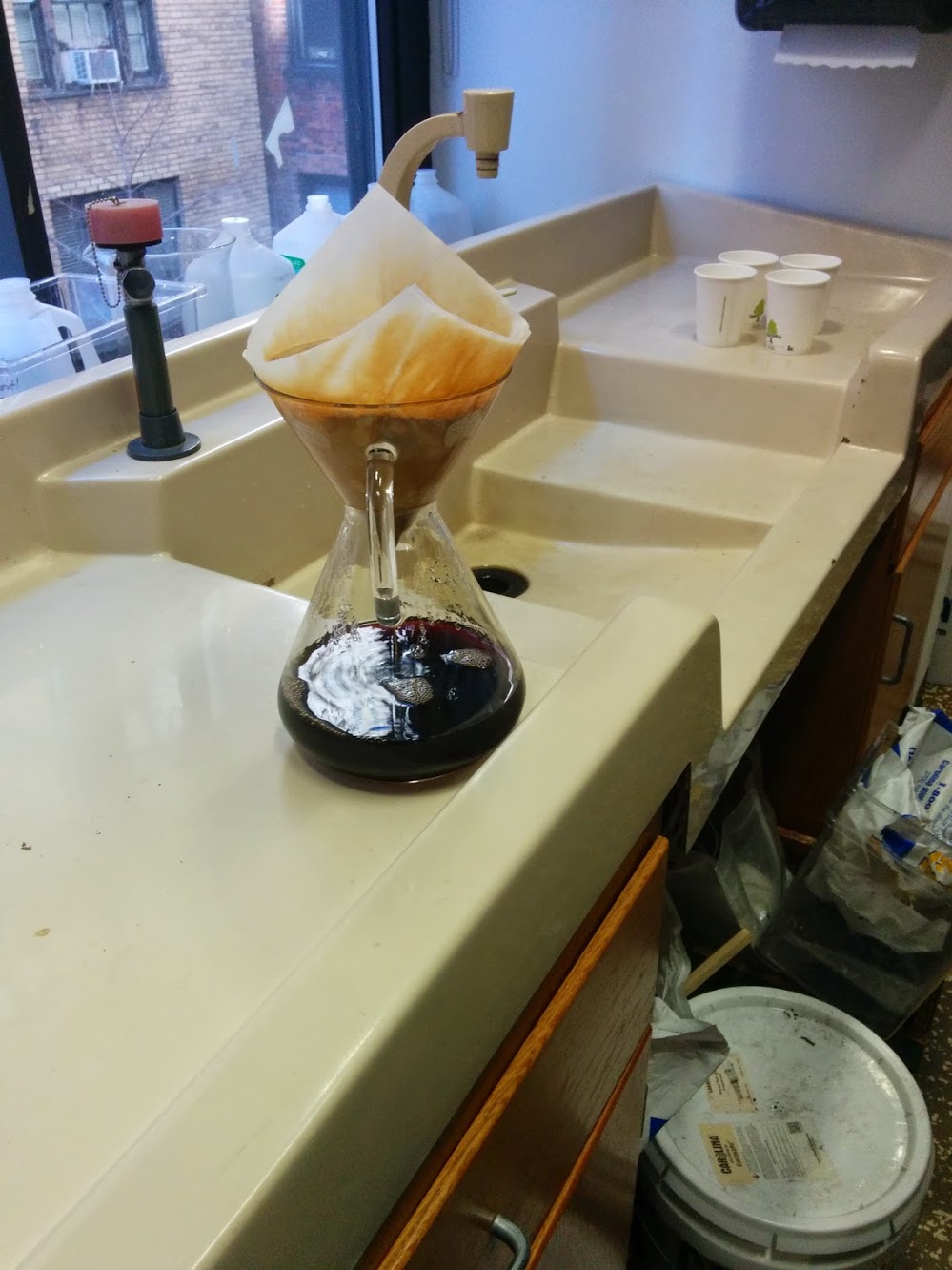
What is this witch’s cauldron? Coffee, I learned! Seen here in a Chemex on the sink of the science lab. 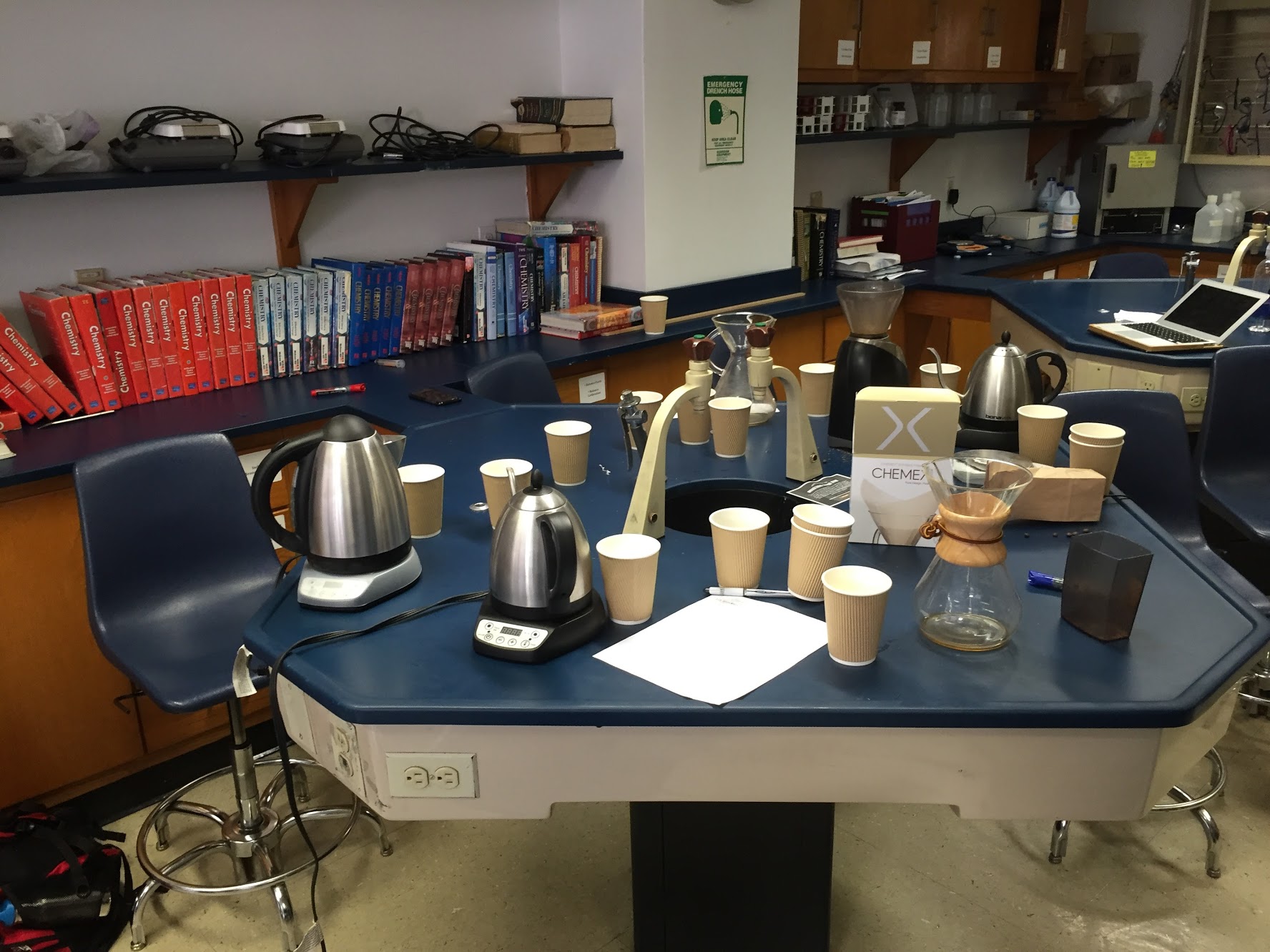
A typical sight after a morning popBeans class: scattered cups, half-drunk coffee (minus the excited students). 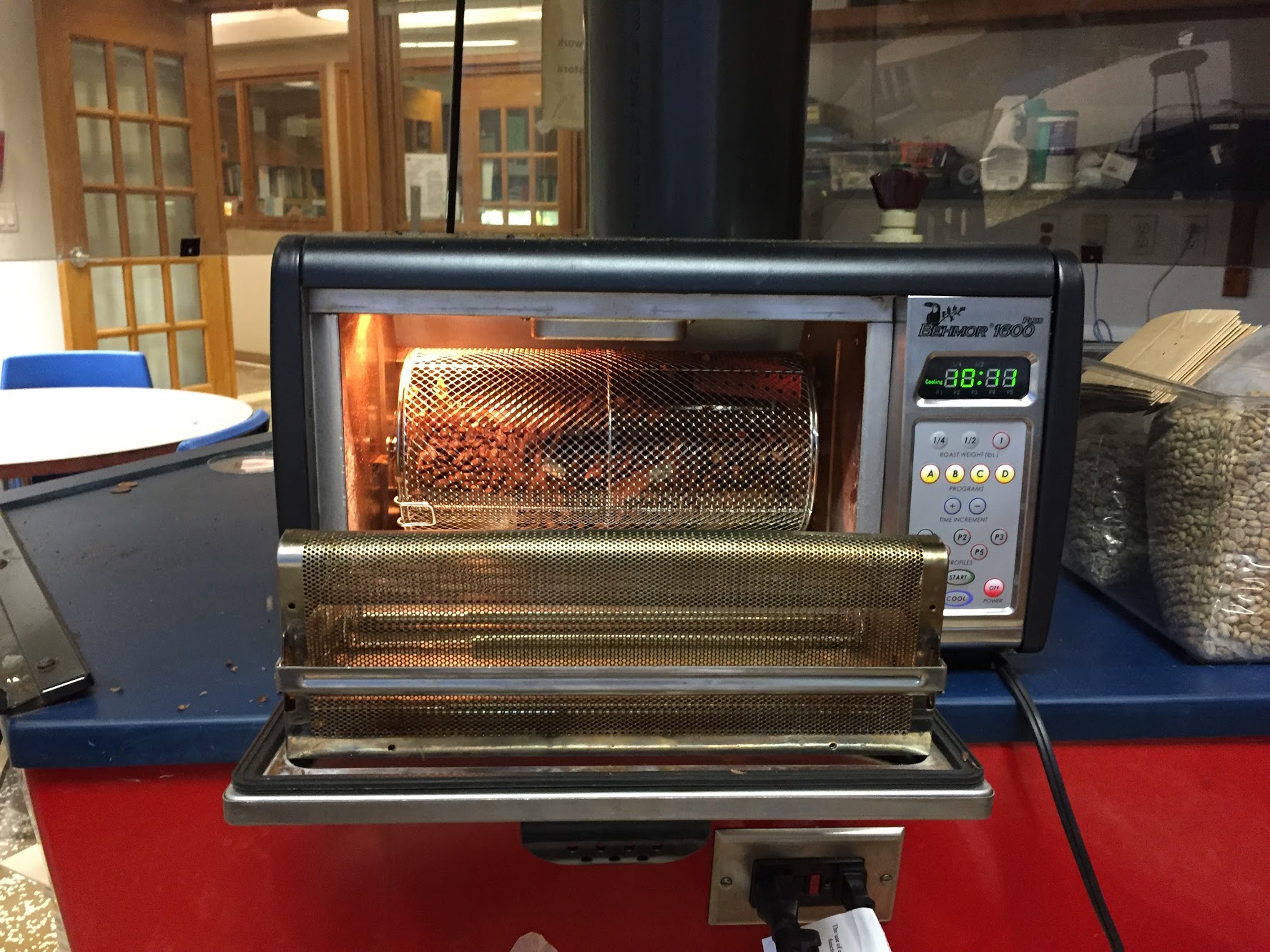
Our beloved roaster, the Behmor 1600, seen here on its cooling cycle after a roast. 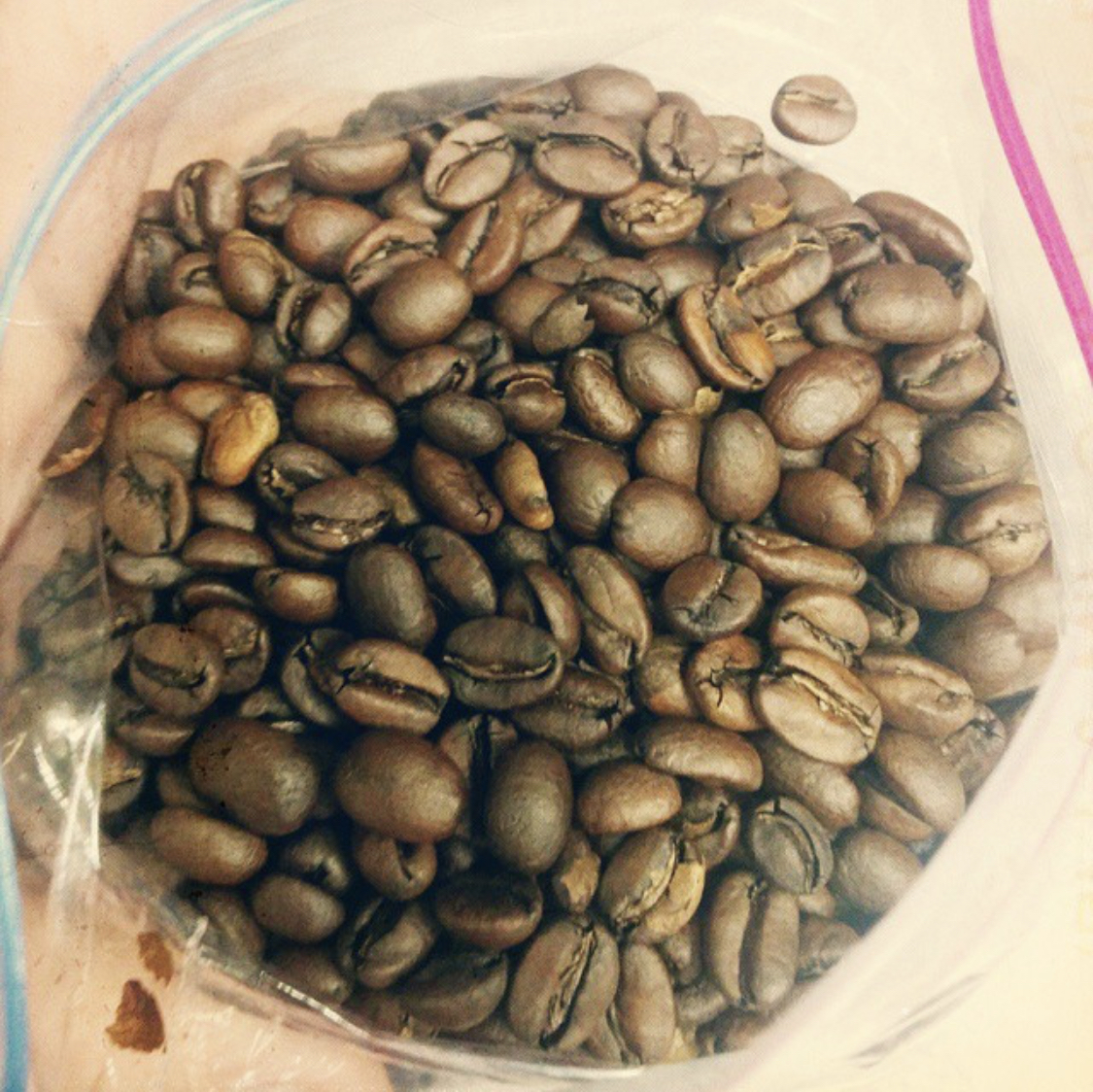
Freshly roasted coffee beans – can you smell them? 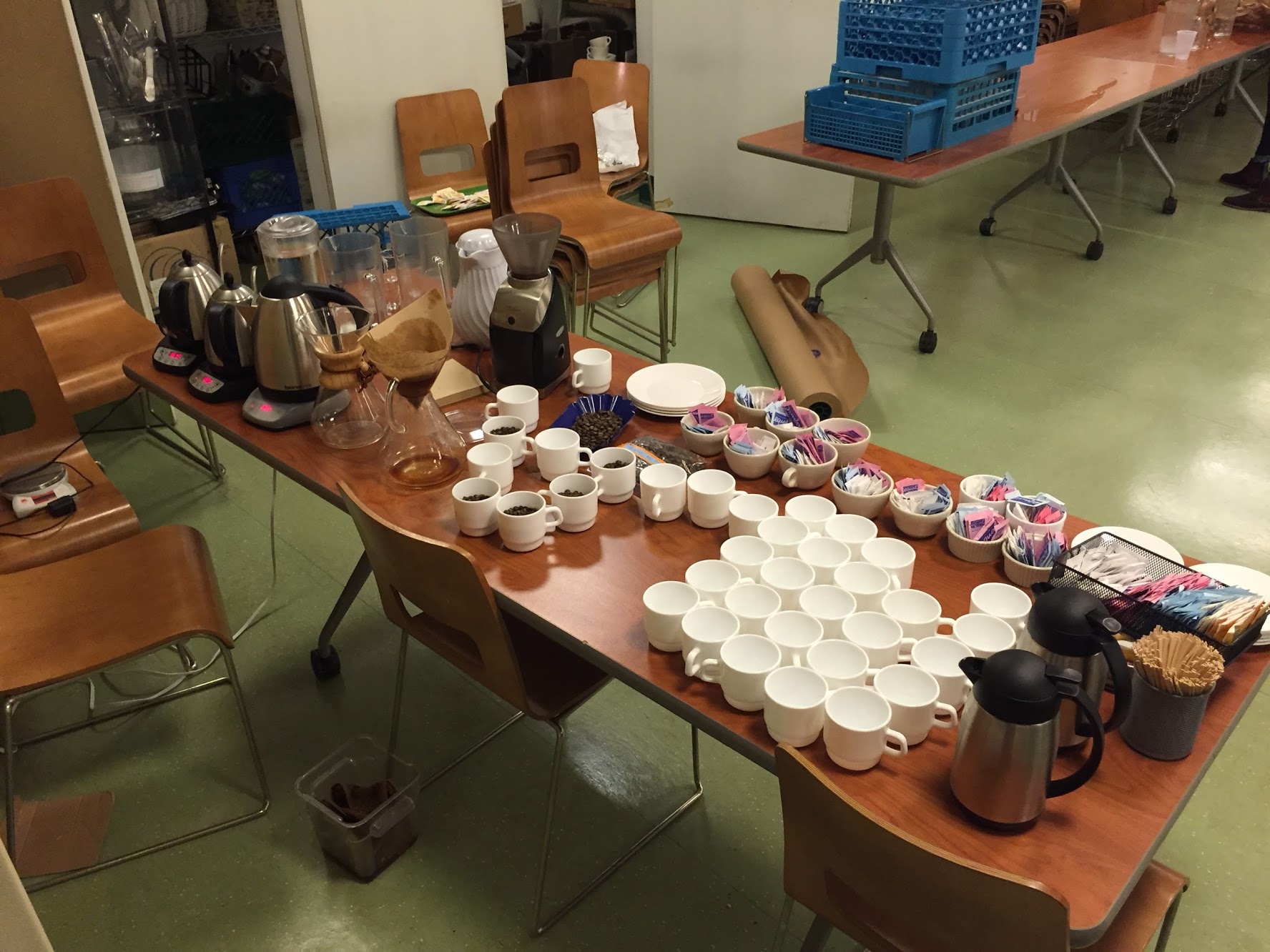
popBeans caters popFood: a table set up in the back of the pop-up restaurant! 
A custom espresso fusion design… La Marzocco, are you listening?
If I didn’t like drinking coffee, though, I loved roasting it. The sights, sounds, and smells of coffee roasting introduced me to a new world of experiences. Even the staunchest coffee hater (like, say, a 15-year-old Alex) admits that they like the smell of coffee, and coffee roasting is just that – with a whole bouquet of smells.
After the roast, I got to brew the coffee on popBean’s Chemex. Making a Chemex felt like conducting a science experiment where I had to carefully dilute a solution to achieve optimal extraction. The result of this experiment, though, wasn’t a percent yield or a scatter plot, but something much more fun. Because I didn’t like drinking the coffee, and because the brewing equipment was kept directly across the hall from the science department, each of popBeans’ pots of coffee was dutifully consumed by Dalton’s science teachers. The brewing experiment, then, resulted in a happily caffeinated science department who could help me with my chemistry homework or talk me through a lab report. Indeed, the symbiotic relationship between my coffee brewing and science teaching was one of the most fruitful I had in my entire educational experience.
I loved popFood coffee. I started a coffee stand at the popFood restaurant, got my own brewing equipment, and roasted coffee every chance I got. I read internet forums on coffee roasting and devoured the Sweet Maria’s website – the source of all of popBeans’ unroasted coffee and much of my original coffee knowledge. I became obsessed. I tried to build my own coffee roaster, design a new coffee brewer, and the summer after that first year of popBeans I made many ideas for my own coffee company. But before I could really do any of that, I needed to learn. So I went to the fanciest coffee neighborhood I could imagine: Williamsburg, Brooklyn.
Part 3: Alexito the Apprentice
On my first ever coffee tour, I wandered the streets of Williamsburg in search of the best coffee I could find. I started with Toby’s Estate, a beautiful cafe and roastery with high ceilings right next to the Bedford Ave subway stop on the L train. I asked for brewer’s choice of their best pour-over, and sipped it quietly while I watched their head roaster work his mastery. Next stop was Oslo’s, which had come up numerous times on lists of “Brooklyn’s Best Coffee” and was within walking distance. Finally, I tried out Blue Bottle on Berry St, which at that time still roasted all their own coffee on premises. At this point, I was three cups of coffee in and starting to feel it. But by chance, I asked the barista at Blue Bottle if they had any more recommendations. The barista tossed out Devocion, a Colombian roastery cafe just around the corner, as a possibility. I was intrigued and headed right over. Simultaneously wired and exhausted (coffee lovers know the feeling all too well), I walked into the store.
For the fourth time that day, I asked for brewer’s choice. I nervously waited, my legs shaking incessantly on the stone floor, for yet more caffeine. I sat there and took in the marvelous view of the store – simultaneously natural and homey – as drinks were called out one after another. As I write this, I remember that on that first trip, they actually forgot my order! I recall waiting upwards of 20 minutes for that pour-over; I was used to 5 or even 10, but this was new. Luckily, the enormous amount of caffeine had sedated me enough to suppress any frustration. I asked again for my drink, and the barista realized that they had forgotten it. The barista profusely apologized, punched out a full punch card good for a free coffee, and assured me my drink would be next. Talk about anticipation!

Just a sampling of Williamsburg’s coffee offerings – no shortage of good stuff! 
I learned how to cup coffee at Devocion, and Sergio got better at his photography skills. 
Stacking fresh bags of coffee was a big part of the job. One day, Sergio and I made a throne with some new bags! 
The Coffee Resume! Quite a funny document to read now 
Samples that I roasted in my first week: notice how they’re either scorched black or 
A day’s work packing boxes was always satisfying. Here we shipped 6 or 7 wholesale accounts and a number of individual buyers.
It was Devocion’s Honey coffee – a blend of honey-processed Colombian coffees. And boy, was it delicious. Perhaps it was the bordering-on-deliriousness state I was in, but that first pour over was something new. I tasted flavors of ripe melons, with a level of sweetness I had never imagined possible. It was awesome. I slurped the full cup, thanked the staff, and headed home. I vividly remember lying on the couch after coming home that day, my heart rate about three times the norm, unable to do anything but dream about coffee. This was it: Devocion. This is where I had to be.
When school let out that summer, I had a plan. I made a “coffee resume” and visited Devocion the first Monday of summer break to chat up the baristas. A soft-spoken, stout Colombian man with impressively long hair stood at the end of the counter. (This, I would learn, was Sergio – Devocion’s master roaster.) The baristas pointed me to him to talk about working there. When I asked if he needed any help, or if I could work with Devocion, he first shrugged. After firing off a few words in Spanish to a colleague, he returned to me and explained “maybe with the bagging.” So that was that – I had an in. I could bag coffee for Sergio, and maybe try to learn a few things. I sent off an email to Devocion’s general info box, and they asked me to come in the next day for an interview.
Steven Sutton, the CEO of Devocion, welcomed me in. As we sat down at his desk, he turned to me and asked his most important question: “Do you speak Spanish?” No, no I did not, unfortunately. I could try to learn, I explained! Steven leaned back in his chair and thought about the proposal. I could bag the coffee, but I wanted to learn. I wanted to work at Devocion to understand coffee. So, as is typical of an under-confident high schooler, I took the job for free, with the agreement that I would work in exchange for knowledge. The plan was to roast samples in the morning, bag coffee and clean during the day, and cup the samples and clean the shop at the end of the day.
————————–
This post isn’t finished yet, but I wanted to send out the blog to family and friends as quickly as possible! Here’s a sampling of what’s to come:
Part 4: Dalton Coffee Roasters
Part 5: Princeton Coffee Club
Part 6: Princeton Coffee Club – but different!
Conclusion: The Road Ahead
 Alex's Coffee Adventure