Today I got to talk to Karen Attman, a local expert on the Colombian coffee scene, and it got me thinking a lot about my goals for this summer and beyond. Karen talked me through a lot of the intricacies of the Colombian market over a few cups of coffee at a couple of cool places around the city. She reminded me a bit of David Waldman, the roaster at Rojo’s in Princeton, as someone who knows everyone and is very forthcoming about their experiences.
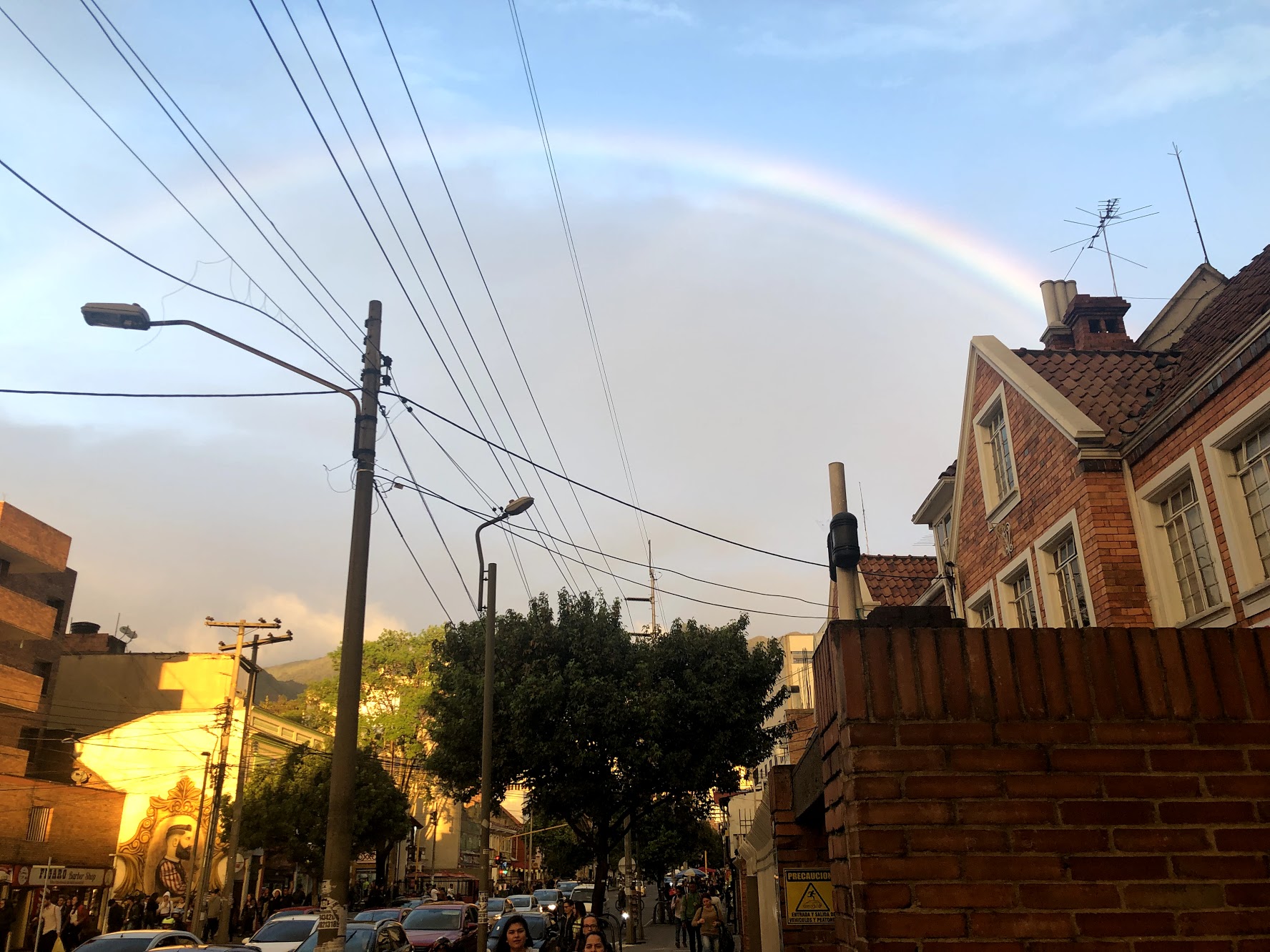
I didn’t take many pictures today, but I did get one great shot:
Here’s a bit about what I learned, and some of the lines of thinking I’m going to try to pursue as I continue learning this summer.
Traditional Colombian Production Ends in Parchment
Traditional coffee production in Colombia follows a very specific format. Smallholder farmers will tend to their land by themselves and maybe with the help of their family. They will harvest their own beans, then pulp them a hand-crank coffee pulper. After pulping, they’ll ferment their beans in some kind of tank, barrel, or bucket to loosen the mucilage. Then they will wash off the mucilage with water and lay the parchment coffee out to dry.
This all sounds pretty similar (hopefully) to what I described two days ago, except with one big part missing: the wet mill. One of the main things I learned today is that wet mills are extremely rare in Colombia, as the vast majority of farmers pulp, ferment, wash, and dry their own coffee.
Farmers will then bring their dried parchment coffee to the local dry mill to sell it. At the dry mill, buyers will dry mill a small sample of the coffee, measure its moisture content, grade it for defects, and pass it through grading screens to measure bean size. Once the various price points are tallied up for moisture, defects, and size grade (about a 20 minute process), the dry mill buyers will purchase the coffee at the daily price set by the Coffee Growers Federation (FNC). The FNC’s prices are publicly displayed, and the FNC also guarantees that coffee will always be bought. The FNC price is pegged to the New York Commodity Exchange price for Coffee – aka the C Price – in addition to the Dollar/Peso exchange rate and the value premium for 100% Colombian.
My big misconception was that most coffees in Colombia are processed at a community wet mill. Indeed, both La Palma and El Fénix run their own wet mill for the community. These are exceptions, though, and not the rule, as I’ve learned.
Wet Mills are Contentious
Far from being a standard part of coffee production, wet mills, or beneficios as they’re called in Spanish, are actually a pretty contentious topic in Colombian coffee production. Karen mentioned that we could talk about “the pros and cons of wet mills,” and I was kind of shocked: what could be the cons of a wet mill station?
From my perspective, wet mills seemed to help everybody as they allowed each member of the supply chain to specialize in their craft. As I wrote about yesterday, wet mills allow farmers to only focus on tending to their crop and picking ripe cherries, instead of having to worry about fermentation and drying methods. I thought that they were great!
The main problem with wet mills, as it turns out, is that prices paid for coffee cherries are (quite obviously) much lower than those for parchment coffee, as the beneficio takes on some of the costs of production. Now, this wouldn’t seem to be a problem if those lower prices were offset by a larger volume of cherries, but few farmers are able to produce more coffee than they’re currently producing.
This seems to be the core issue of wet mills: coffee farmers want to take on the extra labor of processing their own coffee and earn more money for it because they have no other revenue options. If farmers were able to use the time spent on processing coffee elsewhere – say, planting more trees, planting more shade crops and increasing biodiversity, or pruning and replanting trees – this wouldn’t be a problem. But all of those things cost money.
This was quite eye-opening to me. One potential path to increase quality and specialization could be opening a beneficio and a coffee nursery to help farmers plant new trees. But this isn’t popular for another reason: the traditions and culture of growing coffee in Colombia.
Coffee Farmers are Proud of Their Crop
This hurdle to the beneficio/specialization model comes not from economics but from cultural and traditional dispositions. Coffee farmers want to process their own coffee, as it gives them ownership over the product. Once the coffee is in parchment, it really can’t get much better than it is – the dry mill, roaster, and brewer can only mess it up. (I used to say that coffee can’t get much better after the moment the cherry is picked, but La Palma shifted my perspective on what fermentation can do for coffee.) This means that a parchment coffee is the sole product of a single smallholder farmer. Such traceability is an added advantage for buyers, who can go back and buy a microlot from a single smallholder farmer that stands out on the cupping table.
Traceability is another main concern about the wet mill model. Beneficios often mix all the coffee from local producers together; just look at Sweet Maria’s listings, and you’ll find a huge list of coop names. This can disincentive picking ripe cherries or focusing on agricultural quality, if your neighbor’s crop is worse and is still fetching the same price. Of course, it isn’t necessary to mix all of the incoming coffee together in the wet mill, but it is logistically much easier.
There are New Things Everywhere
In addition to the rare examples of La Palma and El Fénix, there are a number of new beneficios throughout the country. Many of these are being financed by Nespresso; Karen told me that Nespresso is working on education efforts and quality partnerships with over 30,000 Colombian coffee farmers.
So wet mills are new, and they have their pros and cons. La Palma and El Fenix are producing some of the best-known coffee in Colombia at the moment, so it’ll be interesting to see if these standout farms influence any broader shift in the market.
Another option that I talked about with the owner of Colo Coffee is to open specialty dry mill stations. Although they’re already common, dry mills allow you to meet farmers where they are by purchasing their traditionally processed parchment coffee. One of the current areas of market inefficiency in this, I think, are poor measures of quality. Right now, moisture content, defect grading, and size are the only proxies for quality that coops (dry mills) pay for. Having proper moisture content, low defect percentages, and large beans are crucial tenets of quality coffee. But if all three of those indicators pan out well, they don’t tell you much more than that the coffee has the potential to be specialty grade. Indeed, right now if a traditional farmer wants to sell their coffee at specialty grade, they first have to sell it to the coop at the standard FNC price, then wait for a specialty buyer to pay a premium which may hopefully make it back to the farmer.
In order to truly incentivize quality, the language and understanding of quality must be better represented at the source.
Quality Coffee is Poorly Understood by Producers
The vast majority of Colombian coffee farmers have never had a cup of filtered coffee. Besides from seeming patently unjust, this lack of coffee backwards propagation to the source means farmers have no idea if their coffee is any good or not. As I said, apart from the three proxies used at the dry mill, farmers have no access to any further understanding of coffee quality.
There are certainly efforts working to address this situation. The Q Grader program itself takes square aim at this: Q Graders are randomly called upon by producing countries’ In-Country Partners (ICPs) to grade samples that they’re sent in the mail. The Q Graders assigned to the coffee must green grade it, roast it to spec, and cup it. The scoring information is then returned to the source to define the coffee as specialty grade or not. I don’t really have a sense for the scale of CQI’s grading program for ICPs, but I expect it’s very small. I’ve read about a few other places trying to introduce the language of quality at the source, but it’s very difficult to achieve this due to constraints in infrastructure, cost, trained personnel, and resources. In order to properly grade coffee at the source, you’d need:
- A reasonable sample coffee roaster ($3,000+)
- Coffee cupping equipment like a grinder and cupping bowls ($600+)
- Water filtration good enough for cupping ($1,500+)
- Dedicated, trained coffee cuppers and graders (?)
- A way to involve and educate producers (?)
- A long-term commitment to the region (???)
You can start to get a sense of the problems facing such efforts. That being said, dedicated feedback channels for local producers are almost certain to help improve quality and grant producers access to the specialty market. It’s difficult to estimate a cost/price ratio on projects like these, but that isn’t stopping them from popping up.
Stars Stand Out
Lastly, a core takeaway is that neighbors take notice of each others’ coffee. If one farm starts to produce top-tier specialty coffee and becomes financially rewarded for their work, neighbors will attempt to replicate that model, resulting in a generous positive feedback loop of better coffee and better prices. While this isn’t a pure instance of market competition, it is a great example of how even basic access to competitors’ financial information can help spur farmers (or really any business) to greater successes.
If a farmer can improve their practices enough to produce specialty coffee, they’ve fought half the battle. The other half is getting paid for those premiums. I’m really not sure yet how easy it is for farmers who are producing top-tier specialty coffee to get rewarded for that, especially if they are unique in their region. This seems like a really important area to investigate more: how delayed is the response between increasing quality in production and increased premiums paid for farmers? Who’s responsible for paying those premiums, at each stage up the supply chain?
All in all, I have a lot to think about. I learned a lot today and I’m looking forward to learning more throughout the summer.
Alex
 Alex's Coffee Adventure
I’m really learning from your observations about the complexities of the coffee market and the circumstances of the growers – fascinating! I can’t wait to hear your recommendations about ways to improve the market dynamics for the growers. Xo!
LikeLike